
Ch.5 - Stereochemistry
Wade - Organic Chemistry 9th Edition
Wade9th EditionOrganic ChemistryISBN: 9780135213728당신이 사용하는 게 아니라요?교과서 변경
5장, 문제 33

(+)-Tartaric acid has a specific rotation Of +12.0°. Calculate the specific rotation of a mixture of 68% (+)-tartaric acid and 32% (–)-tartaric acid.

검증된 단계별 안내
1
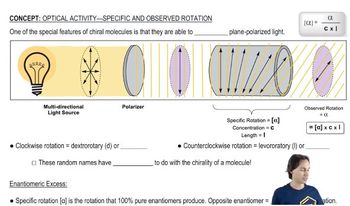
Understand the concept of specific rotation: Specific rotation ([α]) is a measure of a compound's ability to rotate plane-polarized light. It is calculated using the formula: α = αobs / (c × l) , where αobs is the observed rotation, c is the concentration, and l is the path length. For mixtures of enantiomers, the specific rotation is proportional to the enantiomeric excess (ee).
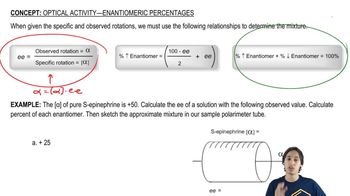
Determine the enantiomeric excess (ee): The enantiomeric excess is calculated as the difference in the percentages of the two enantiomers. Here, the mixture contains 68% (+)-tartaric acid and 32% (-)-tartaric acid. Calculate the ee using the formula: ee = (% ( + ) - % ( - )) .
Relate the enantiomeric excess to the specific rotation: The specific rotation of the mixture is proportional to the enantiomeric excess. Use the formula: αmixture = (ee / 100) × αpure , where αpure is the specific rotation of the pure enantiomer (+12.0° in this case).
Substitute the values into the formula: Plug in the calculated enantiomeric excess and the specific rotation of the pure enantiomer into the formula to find the specific rotation of the mixture.
Simplify the expression to determine the specific rotation of the mixture. Ensure the units are consistent and the final value is expressed in degrees.

비슷한 문제에 대한 검증된 영상 답변:

이 영상 해법은 위 문제에 도움이 된다고 튜터들이 추천한 것입니다.
영상 길이:
2m

주요 개념

질문에 올바르게 답하기 위해 반드시 이해해야 하는 핵심 개념들은 다음과 같습니다.

Specific Rotation

Specific rotation is a property of chiral compounds that quantifies their ability to rotate plane-polarized light. It is defined as the observed rotation of light at a specific wavelength and temperature, divided by the concentration of the solution and the path length of the light. The specific rotation is expressed in degrees and is a crucial parameter in determining the optical purity of a mixture of enantiomers.
추천 영상:
05:43
Specific rotation vs. observed rotation.

Enantiomers

Enantiomers are a pair of molecules that are non-superimposable mirror images of each other, often differing in their optical activity. In the case of tartaric acid, the (+) and (-) forms are enantiomers, with the (+) form rotating light to the right and the (-) form to the left. Understanding the behavior of enantiomers is essential for calculating the specific rotation of mixtures containing both forms.
추천 영상:
03:23
How to solve for the percentage of each enantiomer.

Optical Purity

Optical purity is a measure of the composition of a chiral mixture, expressed as the ratio of the observed specific rotation to the specific rotation of a pure enantiomer. It provides insight into the relative amounts of each enantiomer in a mixture. In this question, calculating the specific rotation of the mixture involves using the proportions of (+) and (-) tartaric acid to determine the overall optical activity.
추천 영상:
08:17
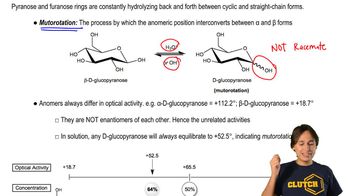
Mutorotation and Optical Activity
관련 실천
교과서 질문

The specific rotation of (S)-2-iodobutane is +15.90°.

a. Draw the structure of (S)-2-iodobutane.

b. Predict the specific rotation of (R)-2-iodobutane.

c. Determine the percentage composition of a mixture of (R)- and (S)-2-iodobutane with a specific rotation of –7.95°.

1132
views
교과서 질문

Draw the enantiomer, if any, for each structure.

(g)

(h)

1231
views
교과서 질문

For each structure,

1. draw all the stereoisomers.

2. label each structure as chiral or achiral.

3. give the relationships between the stereoisomers (enantiomers, diastereomers).

(a)

2314
views
교과서 질문

Calculate the specific rotations of the following samples taken at 25 °C using the sodium D line.

a. 1.00 g of sample is dissolved in 20.0 mL of ethanol. Then 5.00 mL of this solution is placed in a 20.0-cm polarimeter tube. The observed rotation is 1.25° counterclockwise.

1288
views
교과서 질문

Calculate the specific rotations of the following samples taken at 25 °C using the sodium D line.

b. 0.050 g of sample is dissolved in 2.0 mL of ethanol, and this solution is placed in a 2.0-cm polarimeter tube. The observed rotation is clockwise 0.043°.

1129
views
교과서 질문

Free-radical bromination of the following compound introduces bromine primarily at the benzylic position next to the aromatic ring. If the reaction stops at the monobromination stage, two stereoisomers result.

a. Propose a mechanism to show why free-radical halogenation occurs almost exclusively at the benzylic position.

b. Draw the two stereoisomers that result from monobromination at the benzylic position.

c. Assign R and S configurations to the asymmetric carbon atoms in the products.

4053
views