Ch. 7 - Structure and Synthesis of Alkenes; Elimination
Wade - Organic Chemistry 9th Edition
Wade9th EditionOrganic ChemistryISBN: 9780135213728당신이 사용하는 게 아니라요?교과서 변경
7장, 문제 50d

Predict the products formed by sodium hydroxide-promoted dehydrohalogenation of the following compounds. In each case, predict which will be the major product.
d. cis-1-bromo-2-methylcyclohexane

검증된 단계별 안내
1
Identify the reaction type: This is a dehydrohalogenation reaction, which is an elimination reaction (E2 mechanism) promoted by a strong base like sodium hydroxide (NaOH). The reaction involves the removal of a hydrogen atom (β-hydrogen) and a halogen atom (bromine in this case) to form a double bond.
Determine the β-hydrogens: In cis-1-bromo-2-methylcyclohexane, the bromine atom is attached to carbon-1. The β-hydrogens are located on the carbons adjacent to carbon-1 (i.e., carbon-2 and carbon-6). Analyze the stereochemistry of the molecule to identify which β-hydrogens are anti-periplanar to the bromine atom, as this is a requirement for the E2 mechanism.
Apply Zaitsev's rule: Zaitsev's rule states that the major product of an elimination reaction is the more substituted alkene. In this case, consider the possible alkenes that can form by removing β-hydrogens from carbon-2 or carbon-6. The more substituted alkene will be the major product.
Draw the possible products: Removing a β-hydrogen from carbon-2 will form one alkene, while removing a β-hydrogen from carbon-6 will form another. Draw the structures of these alkenes, ensuring that the double bond is placed between carbon-1 and the β-carbon from which the hydrogen was removed.
Determine the major product: Compare the substitution patterns of the alkenes formed. The alkene with more alkyl groups attached to the double-bonded carbons will be the major product, as it is more stable due to hyperconjugation and inductive effects.

비슷한 문제에 대한 검증된 영상 답변:

이 영상 해법은 위 문제에 도움이 된다고 튜터들이 추천한 것입니다.
영상 길이:
2m
도움이 되었나요?

주요 개념

질문에 올바르게 답하기 위해 반드시 이해해야 하는 핵심 개념들은 다음과 같습니다.

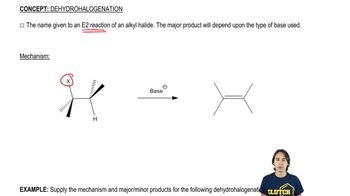
Dehydrohalogenation

Dehydrohalogenation is an elimination reaction where a hydrogen halide (HX) is removed from a molecule, typically resulting in the formation of a double bond. In the context of organic chemistry, this reaction is often facilitated by strong bases like sodium hydroxide (NaOH). The reaction can lead to the formation of alkenes, and the regioselectivity of the product can depend on the structure of the starting material.
추천 영상:
03:02
The dehydrohalogenation mechanism.

Zaitsev's Rule

Zaitsev's Rule states that in elimination reactions, the more substituted alkene is generally the major product. This is because more substituted alkenes are typically more stable due to hyperconjugation and the inductive effect. Understanding this rule is crucial when predicting the major product of dehydrohalogenation, especially when multiple elimination pathways are possible.
추천 영상:
01:18
Defining Zaitsev’s Rule

Stereochemistry of Alkenes

Stereochemistry refers to the spatial arrangement of atoms in molecules and is particularly important in the formation of alkenes. In the case of cis-1-bromo-2-methylcyclohexane, the stereochemical configuration can influence the outcome of the elimination reaction. The formation of trans or cis alkenes can affect stability and reactivity, making it essential to consider stereochemical factors when predicting products.
추천 영상:
가이드 코스
1:38
Polymer Stereochemistry Concept 1