
A double bond in a six-membered ring is usually more stable in an endocyclic position than in an exocyclic position. Hydrogenation data on two pairs of compounds follow. One pair suggests that the energy difference between endocyclic and exocyclic double bonds is about 9 kJ/mol. The other pair suggests an energy difference of about 5 kJ/mol. Which number do you trust as being more representative of the actual energy difference? Explain your answer.
Ch. 7 - Structure and Synthesis of Alkenes; Elimination
7장, 문제 50a,b,c
Predict the products formed by sodium hydroxide-promoted dehydrohalogenation of the following compounds. In each case, predict which will be the major product.
a. 1-bromobutane
b. 2-chlorobutane
c. 3-bromopentane
검증된 단계별 안내1
Identify the type of reaction: Sodium hydroxide (NaOH) in this context promotes a dehydrohalogenation reaction, which is an elimination reaction (E2 mechanism). This involves the removal of a hydrogen atom (β-hydrogen) and a halogen atom (leaving group) to form a double bond.
Determine the β-hydrogens: For each compound, locate the carbon atom bonded to the halogen (α-carbon) and identify the adjacent carbons (β-carbons). Check for the presence of β-hydrogens on these β-carbons.
Apply Zaitsev's rule: In elimination reactions, the major product is typically the more substituted alkene (the one with more alkyl groups attached to the double-bonded carbons). Use this rule to predict the major product for each compound.
Analyze each compound: a) For 1-bromobutane, identify the β-hydrogens on the β-carbons and predict the possible alkenes. b) For 2-chlorobutane, consider the β-hydrogens on both β-carbons and predict the major and minor products based on Zaitsev's rule. c) For 3-bromopentane, follow the same process to predict the products and determine the major one.
Draw the structures of the predicted products: For each compound, draw the possible alkenes formed after elimination and clearly indicate which is the major product based on Zaitsev's rule. Ensure the double bond is placed correctly in the structure.

비슷한 문제에 대한 검증된 영상 답변:
이 영상 해법은 위 문제에 도움이 된다고 튜터들이 추천한 것입니다.
영상 길이:
4m주요 개념
질문에 올바르게 답하기 위해 반드시 이해해야 하는 핵심 개념들은 다음과 같습니다.
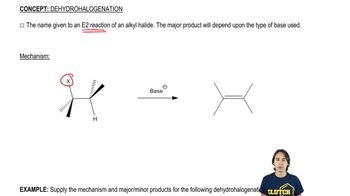
Dehydrohalogenation
Dehydrohalogenation is an elimination reaction where a hydrogen atom and a halogen atom are removed from adjacent carbon atoms in a molecule, typically resulting in the formation of an alkene. This reaction is often promoted by strong bases, such as sodium hydroxide, which facilitate the removal of the halide and proton. Understanding the mechanism and conditions of this reaction is crucial for predicting the products formed.
추천 영상:
The dehydrohalogenation mechanism.
Zaitsev's Rule
Zaitsev's Rule states that in elimination reactions, the more substituted alkene is generally the major product. This is because more substituted alkenes are more stable due to hyperconjugation and the inductive effect. When predicting the products of dehydrohalogenation, applying Zaitsev's Rule helps identify which alkene will be favored based on the structure of the starting material.
추천 영상:
Defining Zaitsev’s Rule
Regioselectivity
Regioselectivity refers to the preference of a chemical reaction to yield one structural isomer over others when multiple products are possible. In the context of dehydrohalogenation, regioselectivity is influenced by the stability of the resulting alkenes. Recognizing which carbon atoms are involved in the elimination process is essential for determining the major product in reactions involving compounds like 1-bromobutane, 2-chlorobutane, and 3-bromopentane.
추천 영상:
Heck Reaction
관련 실천
교과서 질문
4487
views
1
comments
교과서 질문
Predict the products of E1 elimination of the following compounds. Label the major products.
(a)
751
views
교과서 질문
Predict the products formed by sodium hydroxide-promoted dehydrohalogenation of the following compounds. In each case, predict which will be the major product.
d. cis-1-bromo-2-methylcyclohexane
616
views
교과서 질문
Predict the products formed by sodium hydroxide-promoted dehydrohalogenation of the following compounds. In each case, predict which will be the major product.
e. trans-1-bromo-2-methylcyclohexane
668
views
교과서 질문
Predict the products of E1 elimination of the following compounds. Label the major products.
(c)
1628
views
교과서 질문
What halides would undergo E2 dehydrohalogenation to give the following pure alkenes?
a. hex-1-ene
b. isobutylene
c. pent-2-ene
1200
views
