Ch. 7 - Structure and Synthesis of Alkenes; Elimination
Wade - Organic Chemistry 9th Edition
Wade9th EditionOrganic ChemistryISBN: 9780135213728당신이 사용하는 게 아니라요?교과서 변경
7장, 문제 22a

When (1-bromoethyl)cyclohexane is heated in methanol for an extended period of time, five products result: two ethers and three alkenes. Predict the products of this reaction, and propose mechanisms for their formation.

검증된 단계별 안내
1
Step 1: Recognize the reaction conditions. Heating (1-bromoethyl)cyclohexane in methanol suggests a solvolysis reaction, where methanol acts as both the solvent and nucleophile. This indicates that the reaction likely proceeds via an SN1/E1 mechanism due to the polar protic solvent and the secondary alkyl halide.
Step 2: Propose the first step of the mechanism. The bromine atom in (1-bromoethyl)cyclohexane is a good leaving group. Under heat, the C-Br bond breaks heterolytically, forming a secondary carbocation intermediate on the cyclohexane ring. This carbocation is stabilized by hyperconjugation and inductive effects.
Step 3: Predict the formation of ethers. Methanol, acting as a nucleophile, can attack the carbocation to form an ether product. Since methanol can attack from either side of the planar carbocation, two stereoisomeric ethers (R and S configurations) are formed.
Step 4: Predict the formation of alkenes. The carbocation can also undergo elimination (E1 mechanism). A proton from a β-carbon (adjacent to the carbocation) is removed by methanol acting as a base, leading to the formation of alkenes. Three possible alkenes can form due to different β-hydrogens being eliminated, including cis/trans isomers if applicable.
Step 5: Summarize the products. The reaction yields two ethers (stereoisomers) and three alkenes (including possible cis/trans isomers). The mechanisms involve both substitution (SN1) and elimination (E1) pathways, with methanol playing dual roles as a nucleophile and base.

비슷한 문제에 대한 검증된 영상 답변:

이 영상 해법은 위 문제에 도움이 된다고 튜터들이 추천한 것입니다.
영상 길이:
8m

주요 개념

질문에 올바르게 답하기 위해 반드시 이해해야 하는 핵심 개념들은 다음과 같습니다.

Nucleophilic Substitution

Nucleophilic substitution is a fundamental reaction in organic chemistry where a nucleophile attacks an electrophile, replacing a leaving group. In the case of (1-bromoethyl)cyclohexane reacting with methanol, methanol acts as a nucleophile, leading to the formation of ethers through an SN1 or SN2 mechanism, depending on the reaction conditions.
추천 영상:
01:47
Nucleophiles and Electrophiles can react in Substitution Reactions.

Elimination Reactions

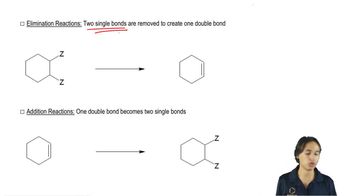
Elimination reactions involve the removal of a small molecule from a larger one, typically resulting in the formation of alkenes. In this scenario, heating (1-bromoethyl)cyclohexane can promote elimination, where the bromine atom is lost along with a hydrogen atom from an adjacent carbon, leading to the formation of alkenes through either E1 or E2 mechanisms.
추천 영상:
00:40
Recognizing Elimination Reactions.

Reaction Mechanisms

Understanding reaction mechanisms is crucial for predicting the products of organic reactions. Mechanisms describe the step-by-step process of how reactants transform into products, including the intermediates formed. In this case, both nucleophilic substitution and elimination pathways must be considered to explain the formation of the observed ethers and alkenes.
추천 영상:
02:16
Heck Reaction Mechanism