Ch.8 - Reactions of Alkenes
Wade - Organic Chemistry 9th Edition
Wade9th EditionOrganic ChemistryISBN: 9780135213728당신이 사용하는 게 아니라요?교과서 변경
8장, 문제 58

Cyclohexene is dissolved in a solution of lithium chloride in chloroform. To this solution is added one equivalent of bromine. The material isolated from this reaction contains primarily a mixture of trans-1,2-dibromocyclohexane and trans-1-bromo-2-chlorocyclohexane. Propose a mechanism to show how these compounds are formed.

검증된 단계별 안내
1
Step 1: Begin by identifying the key reactants and conditions. Cyclohexene is the starting material, bromine (Br₂) is the electrophile, and lithium chloride (LiCl) in chloroform is the solvent. The presence of LiCl suggests that chloride ions (Cl⁻) are available to participate in the reaction.
Step 2: Recognize that bromine reacts with cyclohexene via an electrophilic addition mechanism. Bromine forms a bromonium ion intermediate when it reacts with the double bond of cyclohexene. This occurs as the π-electrons of the double bond attack one bromine atom, while the other bromine atom becomes a leaving group.
Step 3: Consider the stereochemistry of the bromonium ion intermediate. The bromonium ion is cyclic and blocks one face of the molecule, forcing nucleophiles to attack from the opposite side. This anti-addition mechanism leads to trans products.
Step 4: Analyze the role of nucleophiles in the reaction. Bromide ions (Br⁻) and chloride ions (Cl⁻) are both present in the solution. These nucleophiles can attack the bromonium ion intermediate from the opposite side, leading to the formation of trans-1,2-dibromocyclohexane (when Br⁻ attacks) and trans-1-bromo-2-chlorocyclohexane (when Cl⁻ attacks).
Step 5: Summarize the mechanism. The reaction proceeds via electrophilic addition of bromine to cyclohexene, forming a bromonium ion intermediate. Nucleophilic attack by Br⁻ and Cl⁻ on the opposite side of the bromonium ion results in the formation of the two trans products observed in the reaction mixture.

비슷한 문제에 대한 검증된 영상 답변:

이 영상 해법은 위 문제에 도움이 된다고 튜터들이 추천한 것입니다.
영상 길이:
3m

주요 개념

질문에 올바르게 답하기 위해 반드시 이해해야 하는 핵심 개념들은 다음과 같습니다.

Electrophilic Addition Reaction

Electrophilic addition is a fundamental reaction in organic chemistry where an electrophile reacts with a nucleophile, resulting in the addition of atoms or groups across a double bond. In the case of cyclohexene, the double bond acts as a nucleophile, attacking the electrophilic bromine molecule, leading to the formation of a bromonium ion intermediate.
추천 영상:
05:39
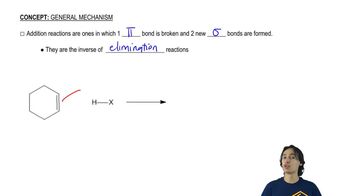
Features of Addition Mechanisms.

Bromonium Ion Mechanism

The bromonium ion mechanism involves the formation of a cyclic bromonium ion when bromine adds to the double bond of cyclohexene. This intermediate is crucial as it stabilizes the positive charge and allows for the subsequent attack by nucleophiles, such as chloride ions, leading to the formation of products like trans-1-bromo-2-chlorocyclohexane.
추천 영상:
가이드 코스
3:39
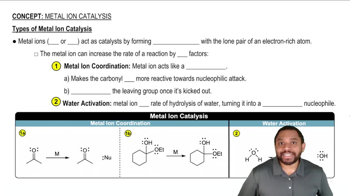
Metal Ion Catalysis Concept 1

Stereochemistry of Addition Reactions

Stereochemistry plays a vital role in determining the configuration of the products formed during addition reactions. In this case, the formation of trans-1,2-dibromocyclohexane and trans-1-bromo-2-chlorocyclohexane indicates that the addition of bromine and chloride occurs in a way that preserves the trans configuration, which is influenced by the mechanism of the bromonium ion and the subsequent nucleophilic attack.
추천 영상:
가이드 코스
1:38
Polymer Stereochemistry Concept 1
관련 실천
교과서 질문

Propose mechanisms consistent with the following reactions.

(g)

1496
views

교과서 질문

Propose mechanisms consistent with the following reactions.

(f)

1520
views
교과서 질문

Draw an approximate reaction-energy diagram showing the curves for the two possible pathways for ionic addition of HBr to 1-methylcyclohexene. (a) Formation of the major product, 1-bromo-1-methylcyclohexane, and (b) formation of the minor product, 1-bromo-2-methylcyclohexane. Point out how these curves show that 1-bromo-1-methylcyclohexane should be formed faster.

2055
views
교과서 질문

One of the constituents of turpentine is α-pinene, formula C10H6. The following scheme (called a “road map”) gives some reactions of α-pinene. Determine the structure of α-pinene and of the reaction products of A through E.

1172
views
교과서 질문

The sex attractant of the housefly has the formula C23H46. When treated with warm potassium permanganate, this pheromone gives two products: CH3(CH2)12COOH and CH3(CH2)7COOH. Suggest a structure for this sex attractant. Explain which part of the structure is uncertain.

1257
views
교과서 질문

Unknown X, C5H9Br does not react with bromine or with dilute KMnO4. Upon treatment with potassium tert-butoxide, X gives only one product, Y, C5H8. Unlike X, Y decolorizes bromine and changes KMnO4 from purple to brown. Catalytic hydrogenation of Y gives methylcyclobutane. Ozonolysis–reduction of Y gives dialdehyde Z, C5H8O2. Propose consistent structures for X, Y, and Z. Is there any aspect of the structure of X that is still unknown?

908
views