Ch.8 - Reactions of Alkenes
Wade - Organic Chemistry 9th Edition
Wade9th EditionOrganic ChemistryISBN: 9780135213728당신이 사용하는 게 아니라요?교과서 변경
8장, 문제 56g

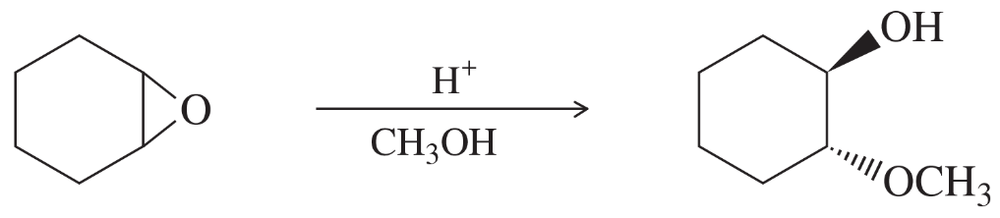
Propose mechanisms consistent with the following reactions.
(g)

검증된 단계별 안내
1
Step 1: Analyze the starting material, which is an epoxide (a three-membered cyclic ether). Epoxides are highly strained and reactive due to the angle strain in the three-membered ring.
Step 2: Recognize the reaction conditions. The presence of H⁺ (acidic conditions) and CH₃OH (methanol) suggests that the epoxide will undergo acid-catalyzed ring opening. Acidic conditions protonate the oxygen atom in the epoxide, making it more electrophilic.
Step 3: Protonation of the epoxide oxygen occurs first. The lone pair on the oxygen atom interacts with H⁺, forming a positively charged oxonium ion. This step increases the electrophilicity of the epoxide and facilitates nucleophilic attack.
Step 4: Methanol (CH₃OH) acts as the nucleophile and attacks one of the carbon atoms in the epoxide ring. The attack occurs at the more substituted carbon atom due to the stability of the resulting carbocation-like transition state. This leads to the opening of the epoxide ring.
Step 5: Deprotonation of the methanol group occurs, resulting in the formation of the final product. The product contains an alcohol (-OH) group and a methoxy (-OCH₃) group on adjacent carbons, with stereochemistry determined by the anti-addition mechanism of the ring opening.

비슷한 문제에 대한 검증된 영상 답변:

이 영상 해법은 위 문제에 도움이 된다고 튜터들이 추천한 것입니다.
영상 길이:
12m

주요 개념

질문에 올바르게 답하기 위해 반드시 이해해야 하는 핵심 개념들은 다음과 같습니다.

Electrophilic Addition

Electrophilic addition is a fundamental reaction mechanism in organic chemistry where an electrophile reacts with a nucleophile, resulting in the formation of a new bond. In the context of the provided reaction, the carbonyl group (C=O) acts as an electrophile, attracting nucleophiles such as methanol (CH3OH) in the presence of an acid catalyst (H+). This mechanism is crucial for understanding how the reactants transform into the product.
추천 영상:
09:23
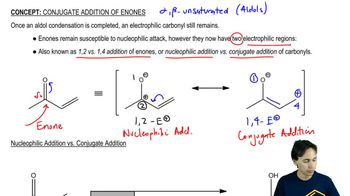
1,2 vs 1,4 Addition

Protonation of Carbonyls

Protonation of carbonyls involves the addition of a proton (H+) to the oxygen atom of a carbonyl group, increasing its electrophilicity. This step is essential in the mechanism as it makes the carbonyl carbon more susceptible to nucleophilic attack. In the reaction shown, the carbonyl oxygen is protonated, facilitating the subsequent attack by methanol and leading to the formation of a hemiacetal.
추천 영상:
04:20
Carboxylic Acids Nomenclature

Hemiacetal Formation

Hemiacetal formation occurs when an alcohol reacts with an aldehyde or ketone, resulting in a compound that contains both an alcohol (-OH) and an ether (-O-R) functional group. In the reaction depicted, methanol adds to the protonated carbonyl, yielding a hemiacetal. This intermediate is significant in organic synthesis and can further react to form acetals under certain conditions.
추천 영상:
06:23
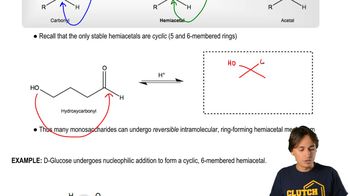
Monosaccharides - Forming Cyclic Hemiacetals