

Ch.8 - Reactions of Alkenes
Wade - Organic Chemistry 9th Edition
Wade9th EditionOrganic ChemistryISBN: 9780135213728당신이 사용하는 게 아니라요?교과서 변경
8장, 문제 21e

Predict the major product(s) for each reaction. Include stereochemistry where appropriate.
e. 1-methylcyclopentene + Br2 in saturated aqueous NaCl

검증된 단계별 안내
1
Step 1: Recognize the type of reaction. The addition of Br2 to an alkene is a halogenation reaction, which typically proceeds via an anti-addition mechanism. The presence of saturated aqueous NaCl introduces the possibility of competing nucleophiles (Br⁻ and Cl⁻).
Step 2: Analyze the mechanism. The reaction begins with the electrophilic attack of Br2 on the double bond of 1-methylcyclopentene, forming a bromonium ion intermediate. This intermediate is a three-membered ring structure with a positive charge on the bromine atom.
Step 3: Consider the nucleophiles present. In saturated aqueous NaCl, both Br⁻ and Cl⁻ are available as nucleophiles. These nucleophiles can attack the bromonium ion from the opposite side of the ring (anti-addition), leading to the formation of trans products.
Step 4: Predict the stereochemistry. The attack by the nucleophile (Br⁻ or Cl⁻) occurs on the opposite side of the bromonium ion, resulting in anti-addition. This means the two substituents (Br and Cl or Br and Br) will be added to opposite faces of the cyclopentane ring.
Step 5: Identify the major product(s). The major products will be trans-1-bromo-2-chloro-1-methylcyclopentane and trans-1,2-dibromo-1-methylcyclopentane, depending on whether Cl⁻ or Br⁻ acts as the nucleophile. The stereochemistry should be clearly indicated in the product structures.

비슷한 문제에 대한 검증된 영상 답변:

이 영상 해법은 위 문제에 도움이 된다고 튜터들이 추천한 것입니다.
영상 길이:
7m
도움이 되었나요?

주요 개념

질문에 올바르게 답하기 위해 반드시 이해해야 하는 핵심 개념들은 다음과 같습니다.

Electrophilic Addition Reactions

Electrophilic addition reactions involve the addition of electrophiles to alkenes or alkynes, where the double or triple bond acts as a nucleophile. In the case of 1-methylcyclopentene reacting with Br2, the alkene undergoes a reaction with bromine, leading to the formation of a vicinal dibromide. Understanding the mechanism of this reaction is crucial for predicting the major product.
추천 영상:
05:39
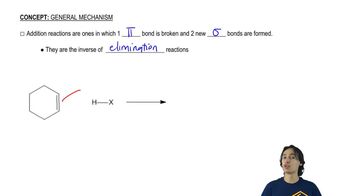
Features of Addition Mechanisms.

Stereochemistry

Stereochemistry refers to the spatial arrangement of atoms in molecules and how this affects their chemical behavior. In the reaction of 1-methylcyclopentene with Br2, the formation of a bromonium ion intermediate can lead to different stereochemical outcomes, including the possibility of forming enantiomers. Recognizing the stereochemical implications is essential for accurately predicting the products.
추천 영상:
가이드 코스
1:38
Polymer Stereochemistry Concept 1

Regioselectivity

Regioselectivity is the preference of a chemical reaction to yield one structural isomer over others when multiple products are possible. In the reaction of 1-methylcyclopentene with Br2 in aqueous NaCl, the regioselectivity will determine which carbon atoms of the alkene bond with bromine. This concept is important for understanding the distribution of products and the major product formed in the reaction.
추천 영상:
05:09
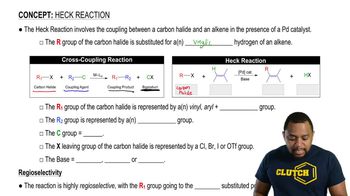
Heck Reaction