Ch.8 - Reactions of Alkenes
Wade - Organic Chemistry 9th Edition
Wade9th EditionOrganic ChemistryISBN: 9780135213728당신이 사용하는 게 아니라요?교과서 변경
8장, 문제 20b

The solutions to Solved Problem 8-6 showed only how one enantiomer of the product is formed. For each product, show how an equally probable reaction forms the other enantiomer.

검증된 단계별 안내
1
Step 1: Begin by identifying the stereocenter in the product molecule. A stereocenter is an atom, typically carbon, bonded to four different groups, leading to chirality.
Step 2: Analyze the reaction mechanism provided in the solved problem. Determine the step where chirality is introduced, such as during the attack of a nucleophile or the formation of a new bond.
Step 3: Consider the spatial arrangement of the reactants and intermediates. For the formation of the other enantiomer, the attack or bond formation must occur from the opposite side (e.g., if the nucleophile attacks from the top face in the solved problem, it should attack from the bottom face for the other enantiomer).
Step 4: Draw the reaction pathway leading to the formation of the second enantiomer. Ensure that the stereochemistry is inverted at the stereocenter compared to the original product. Use wedge and dash bonds to clearly depict the 3D arrangement of atoms.
Step 5: Verify that the two products are non-superimposable mirror images of each other, confirming that they are enantiomers. Highlight that both enantiomers are formed with equal probability if the reaction conditions do not favor one face over the other.

비슷한 문제에 대한 검증된 영상 답변:

이 영상 해법은 위 문제에 도움이 된다고 튜터들이 추천한 것입니다.
영상 길이:
3m
도움이 되었나요?

주요 개념

질문에 올바르게 답하기 위해 반드시 이해해야 하는 핵심 개념들은 다음과 같습니다.

Enantiomers

Enantiomers are a type of stereoisomer that are non-superimposable mirror images of each other. They have identical physical properties except for their interaction with polarized light and reactions in chiral environments. Understanding enantiomers is crucial for grasping how different reaction pathways can lead to the formation of each enantiomer in a chemical reaction.
추천 영상:
03:23
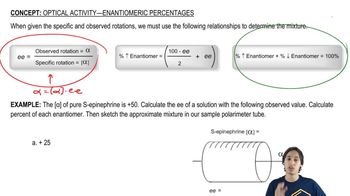
How to solve for the percentage of each enantiomer.

Chirality

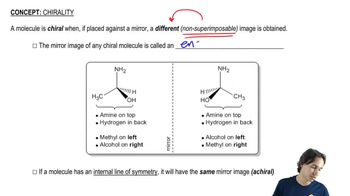
Chirality refers to the geometric property of a molecule that makes it non-superimposable on its mirror image. A chiral molecule typically has at least one carbon atom bonded to four different substituents, creating two distinct forms (enantiomers). Recognizing chirality is essential for predicting the outcomes of reactions that produce enantiomers.
추천 영상:
05:10
What is chirality?

Reaction Mechanisms

Reaction mechanisms describe the step-by-step sequence of events that occur during a chemical reaction. They provide insight into how reactants are transformed into products, including the formation of intermediates and transition states. Understanding the mechanism is vital for illustrating how both enantiomers can be produced from a single reaction setup.
추천 영상:
02:16
Heck Reaction Mechanism