Ch.8 - Reactions of Alkenes
Wade - Organic Chemistry 9th Edition
Wade9th EditionOrganic ChemistryISBN: 9780135213728당신이 사용하는 게 아니라요?교과서 변경
8장, 문제 50i

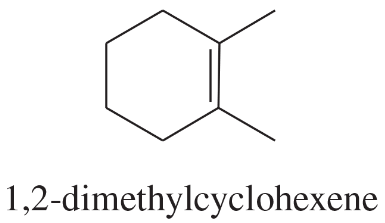
Using 1,2-dimethylcyclohexene as your starting material, show how you would synthesize the following compounds. (Once you have shown how to synthesize a compound, you may use it as the starting material in any later parts of this problem.) If a chiral product is shown, assume that it is part of a racemic mixture.

(i)

검증된 단계별 안내
1
Step 1: Analyze the starting material, 1,2-dimethylcyclohexene. It is a cyclohexene ring with two methyl groups attached to the 1 and 2 positions. The double bond is located between the 1 and 2 carbons.
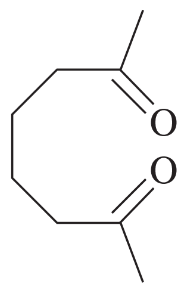
Step 2: Identify the target compound. The target structure is a diketone with two ketone groups at the 1 and 2 positions of the cyclohexane ring. This suggests oxidative cleavage of the double bond in the starting material.
Step 3: Select an appropriate reagent for oxidative cleavage. Use a strong oxidizing agent such as potassium permanganate (KMnO₄) or ozone (O₃) followed by reductive workup (e.g., zinc and acetic acid) to cleave the double bond and form the diketone.
Step 4: Perform the reaction. Treat 1,2-dimethylcyclohexene with ozone (O₃) in the presence of a solvent like dichloromethane, followed by reductive workup using zinc and acetic acid. This will cleave the double bond and oxidize the carbons to ketones.
Step 5: Verify the product. The resulting compound should be the desired diketone with two ketone groups at the 1 and 2 positions of the cyclohexane ring, matching the target structure.

비슷한 문제에 대한 검증된 영상 답변:

이 영상 해법은 위 문제에 도움이 된다고 튜터들이 추천한 것입니다.
영상 길이:
3m

주요 개념

질문에 올바르게 답하기 위해 반드시 이해해야 하는 핵심 개념들은 다음과 같습니다.

Synthesis Reactions

Synthesis reactions in organic chemistry involve the transformation of starting materials into more complex products through various chemical reactions. Understanding the mechanisms and conditions required for these reactions is crucial for predicting the outcomes and identifying the necessary reagents. In this context, synthesizing compounds from 1,2-dimethylcyclohexene requires knowledge of functional group transformations and reaction pathways.
추천 영상:
가이드 코스
1:16
Synthesis of Amino Acids: Strecker Synthesis Example 1

Ozonolysis

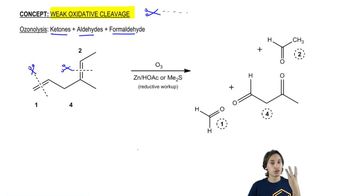
Ozonolysis is a reaction involving the cleavage of alkenes using ozone (O3), resulting in the formation of carbonyl compounds such as aldehydes or ketones. This reaction is particularly useful for breaking double bonds and generating new functional groups. In the context of the question, ozonolysis can be applied to 1,2-dimethylcyclohexene to produce specific products that can be further transformed in subsequent synthesis steps.
추천 영상:
06:30
General properties of ozonolysis.

Chirality and Racemic Mixtures

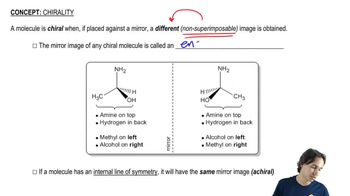
Chirality refers to the property of a molecule that makes it non-superimposable on its mirror image, often resulting in two enantiomers. A racemic mixture contains equal amounts of both enantiomers, leading to no optical activity. Understanding chirality is essential when synthesizing compounds that may exhibit stereochemistry, as it affects the properties and reactivity of the products derived from 1,2-dimethylcyclohexene.
추천 영상:
05:10
What is chirality?