
Ch.9 - Alkynes
Wade - Organic Chemistry 9th Edition
Wade9th EditionOrganic ChemistryISBN: 9780135213728당신이 사용하는 게 아니라요?교과서 변경
9장, 문제 21c

For each compound, give the product(s) expected from (1) HgSO4/H2SO4 - catalyzed hydration and (2) hydroboration–oxidation.
c. hex-3-yne

검증된 단계별 안내
1
Step 1: Analyze the structure of hex-3-yne. It is a six-carbon alkyne with a triple bond located between carbons 3 and 4. This is a symmetrical internal alkyne.
Step 2: For HgSO4/H2SO4-catalyzed hydration, the reaction follows Markovnikov's rule. The triple bond undergoes hydration to form an enol intermediate, which tautomerizes to a ketone. The ketone will form at the more substituted carbon of the triple bond.
Step 3: For hydroboration-oxidation, the reaction follows anti-Markovnikov's rule. The triple bond undergoes hydroboration with a bulky borane reagent, followed by oxidation with H2O2/NaOH. This results in the formation of an enol intermediate, which tautomerizes to an aldehyde. The aldehyde will form at the less substituted carbon of the triple bond.
Step 4: Write the expected products for each reaction. For HgSO4/H2SO4-catalyzed hydration, the product will be a ketone. For hydroboration-oxidation, the product will be an aldehyde.
Step 5: Ensure the stereochemistry and regiochemistry of the products are consistent with the reaction mechanisms. Verify that the ketone and aldehyde products are correctly positioned based on Markovnikov and anti-Markovnikov rules.

비슷한 문제에 대한 검증된 영상 답변:

이 영상 해법은 위 문제에 도움이 된다고 튜터들이 추천한 것입니다.
영상 길이:
11m
도움이 되었나요?

주요 개념

질문에 올바르게 답하기 위해 반드시 이해해야 하는 핵심 개념들은 다음과 같습니다.

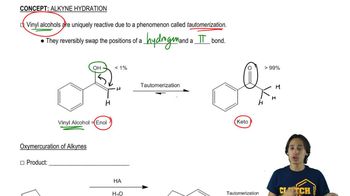
Alkyne Hydration

Alkyne hydration involves the addition of water across the triple bond of an alkyne, typically catalyzed by acids like HgSO4 and H2SO4. This reaction leads to the formation of a carbonyl compound, such as a ketone, through a Markovnikov addition mechanism, where the more substituted carbon atom receives the hydroxyl group.
추천 영상:
09:11
Alkyne Hydration

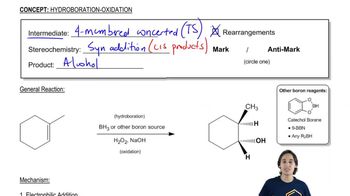
Hydroboration-Oxidation

Hydroboration-oxidation is a two-step reaction that converts alkynes into alcohols. In the first step, borane (BH3) adds to the alkyne in a syn addition, resulting in a trialkylborane intermediate. The second step involves oxidation with hydrogen peroxide and sodium hydroxide, yielding an alcohol with anti-Markovnikov orientation, where the hydroxyl group attaches to the less substituted carbon.
추천 영상:
06:38
General properties of hydroboration-oxidation.

Markovnikov's Rule

Markovnikov's Rule states that in the addition of HX to an alkene or alkyne, the hydrogen atom will attach to the carbon with the greater number of hydrogen atoms already attached. This principle helps predict the outcome of hydration reactions, guiding the formation of more stable carbocation intermediates and influencing the final product distribution in reactions involving unsaturated hydrocarbons.
추천 영상:
03:54
The 18 and 16 Electron Rule