Ch.9 - Alkynes
Wade - Organic Chemistry 9th Edition
Wade9th EditionOrganic ChemistryISBN: 9780135213728당신이 사용하는 게 아니라요?교과서 변경
9장, 문제 20b

The hydroboration–oxidation of internal alkynes produces ketones.
b. When hydroboration–oxidation is applied to pent-2-yne, two products are obtained. Show why a mixture of products should be expected with any unsymmetrical ­internal alkyne.

검증된 단계별 안내
1
Step 1: Begin by understanding the hydroboration–oxidation reaction mechanism. Hydroboration involves the addition of a borane (BH₃ or a derivative) to the alkyne, followed by oxidation with hydrogen peroxide (H₂O₂) in a basic solution (NaOH). This reaction converts alkynes into alcohols, which subsequently tautomerize to ketones.
Step 2: Recognize that pent-2-yne is an unsymmetrical internal alkyne. Its structure is CH₃-C≡C-CH₂-CH₃. The unsymmetrical nature arises because the two groups attached to the triple bond (CH₃ and CH₂CH₃) are different.
Step 3: During hydroboration, the boron atom adds to one of the carbons in the triple bond, while the hydrogen adds to the other carbon. Since pent-2-yne is unsymmetrical, boron can add to either carbon in the triple bond, leading to two different intermediates.
Step 4: In the oxidation step, the boron-containing intermediate is converted into an alcohol. The alcohols formed from the two intermediates will undergo tautomerization (a chemical equilibrium process) to produce two different ketones. This is why a mixture of products is expected.
Step 5: To visualize the products, consider the two possible ketones: one where the carbonyl group forms on the CH₃ side of the triple bond, and the other where the carbonyl group forms on the CH₂CH₃ side. These two ketones are structural isomers, explaining the mixture of products.

비슷한 문제에 대한 검증된 영상 답변:

이 영상 해법은 위 문제에 도움이 된다고 튜터들이 추천한 것입니다.
영상 길이:
9m

주요 개념

질문에 올바르게 답하기 위해 반드시 이해해야 하는 핵심 개념들은 다음과 같습니다.

Hydroboration-Oxidation Reaction

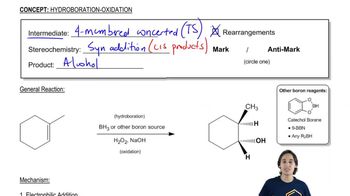
The hydroboration-oxidation reaction is a two-step process used to convert alkenes and alkynes into alcohols. In the first step, borane (BH3) adds across the double or triple bond, resulting in a trialkylborane intermediate. The second step involves oxidation with hydrogen peroxide (H2O2) in a basic solution, converting the boron to a hydroxyl group. This reaction is notable for its anti-Markovnikov addition, leading to the formation of products with specific regioselectivity.
추천 영상:
06:38
General properties of hydroboration-oxidation.

Regioselectivity in Unsymmetrical Alkynes

Regioselectivity refers to the preference of a chemical reaction to yield one structural isomer over others when multiple possibilities exist. In the case of unsymmetrical internal alkynes, hydroboration can lead to different products depending on which carbon of the alkyne the boron adds to. This results in a mixture of ketones, as the reaction can produce different carbonyl groups based on the regioselective addition of boron.
추천 영상:
09:11
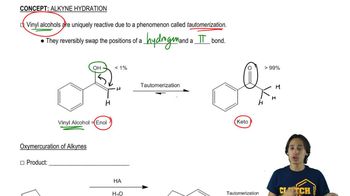
Alkyne Hydration

Formation of Ketones from Alkynes

When internal alkynes undergo hydroboration-oxidation, the resulting products are ketones. The reaction mechanism involves the addition of boron to the alkyne, followed by oxidation to form a carbonyl group. For unsymmetrical internal alkynes, the position of the carbonyl group can vary, leading to the formation of two different ketones. This illustrates the importance of understanding the structure of the starting alkyne in predicting the products of the reaction.
추천 영상:
05:26
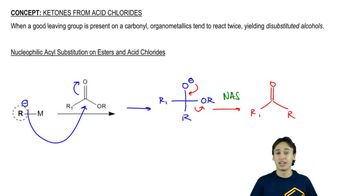
Ketones from acid chlorides