Ch.9 - Alkynes
Wade - Organic Chemistry 9th Edition
Wade9th EditionOrganic ChemistryISBN: 9780135213728당신이 사용하는 게 아니라요?교과서 변경
9장, 문제 18a,b,c

Show how hex-1-yne might be converted to
a. 1,2-dichlorohex-1-ene.
b. 1-bromohex-1-ene.
c. 2-bromohex-1-ene.

검증된 단계별 안내
1
Step 1: For part (a), to convert hex-1-yne to 1,2-dichlorohex-1-ene, perform an electrophilic addition reaction using Cl₂ in the presence of a solvent like CCl₄. The alkyne undergoes partial addition of chlorine, resulting in the formation of a dichlorinated alkene. The chlorine atoms will add across the triple bond, forming 1,2-dichlorohex-1-ene.
Step 2: For part (b), to convert hex-1-yne to 1-bromohex-1-ene, use HBr as the reagent. This reaction follows Markovnikov's rule, where the bromine atom adds to the more substituted carbon of the triple bond, resulting in 1-bromohex-1-ene. The reaction stops at the alkene stage due to controlled conditions.
Step 3: For part (c), to convert hex-1-yne to 2-bromohex-1-ene, use HBr in the presence of a peroxide (e.g., ROOR). This reaction follows anti-Markovnikov's rule due to the radical mechanism induced by the peroxide. The bromine atom adds to the less substituted carbon of the triple bond, forming 2-bromohex-1-ene.
Step 4: Ensure that the reaction conditions are carefully controlled to prevent further addition of halogens or hydrogen halides to the alkene product. For example, use stoichiometric amounts of reagents and monitor the reaction progress.
Step 5: After each reaction, purify the product using techniques such as distillation or chromatography to isolate the desired compound and confirm its structure using spectroscopic methods like NMR or IR.

비슷한 문제에 대한 검증된 영상 답변:

이 영상 해법은 위 문제에 도움이 된다고 튜터들이 추천한 것입니다.
영상 길이:
8m
도움이 되었나요?

주요 개념

질문에 올바르게 답하기 위해 반드시 이해해야 하는 핵심 개념들은 다음과 같습니다.

Alkyne Reactivity

Alkynes, such as hex-1-yne, are characterized by a carbon-carbon triple bond, which makes them highly reactive. This reactivity allows them to undergo various addition reactions, where reagents can add across the triple bond. Understanding the mechanisms of these reactions is crucial for converting alkynes into alkenes or other functional groups.
추천 영상:
09:11
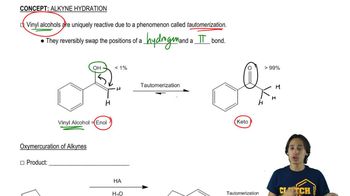
Alkyne Hydration

Halogenation of Alkenes

Halogenation involves the addition of halogens (like Cl or Br) to alkenes, resulting in the formation of dihalides or haloalkenes. The reaction typically proceeds via an electrophilic addition mechanism, where the double bond acts as a nucleophile. Recognizing how to control the regioselectivity of these reactions is essential for synthesizing specific products like 1,2-dichlorohex-1-ene.
추천 영상:
03:45
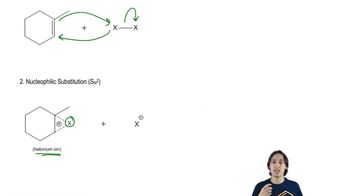
Halogenation Mechanism

Regioselectivity in Organic Reactions

Regioselectivity refers to the preference of a chemical reaction to yield one structural isomer over others when multiple possibilities exist. In the context of converting hex-1-yne to various bromoalkenes, understanding how to direct the addition of bromine to specific carbon atoms is vital. This concept is particularly important when distinguishing between products like 1-bromohex-1-ene and 2-bromohex-1-ene.
추천 영상:
02:17
Identifying organic molecules