Ch.9 - Alkynes
Wade - Organic Chemistry 9th Edition
Wade9th EditionOrganic ChemistryISBN: 9780135213728당신이 사용하는 게 아니라요?교과서 변경
9장, 문제 18e

Show how hex-1-yne might be converted to
e. 2-bromohexane.

검증된 단계별 안내
1
Identify the starting material (hex-1-yne) and the target product (2-bromohexane). Hex-1-yne is an alkyne, and 2-bromohexane is an alkane with a bromine atom on the second carbon. This suggests a multi-step reaction involving reduction and halogenation.
Step 1: Perform a partial reduction of hex-1-yne to hex-1-ene. Use a Lindlar catalyst (Pd/CaCO₃ poisoned with lead or quinoline) and hydrogen gas (H₂). This will selectively reduce the alkyne to a cis-alkene without further reducing it to an alkane.
Step 2: Carry out a hydrohalogenation reaction to add a bromine atom to the second carbon of the hex-1-ene. Use HBr (hydrobromic acid) as the reagent. According to Markovnikov's rule, the bromine will add to the more substituted carbon (C-2), while the hydrogen will add to the less substituted carbon (C-1).
Step 3: Verify the product structure. The resulting compound should be 2-bromohexane, with the bromine atom attached to the second carbon of the hexane chain.
Step 4: Purify the product if necessary, using techniques such as distillation or recrystallization, to isolate 2-bromohexane in its pure form.

비슷한 문제에 대한 검증된 영상 답변:

이 영상 해법은 위 문제에 도움이 된다고 튜터들이 추천한 것입니다.
영상 길이:
1m
도움이 되었나요?

주요 개념

질문에 올바르게 답하기 위해 반드시 이해해야 하는 핵심 개념들은 다음과 같습니다.

Alkyne Reactivity

Alkynes, such as hex-1-yne, are hydrocarbons containing a carbon-carbon triple bond. This triple bond makes them more reactive than alkenes and alkanes, allowing them to undergo various reactions, including halogenation. Understanding the reactivity of alkynes is crucial for predicting the products of their reactions.
추천 영상:
가이드 코스
09:11
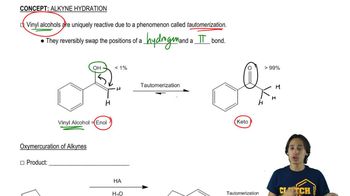
Alkyne Hydration

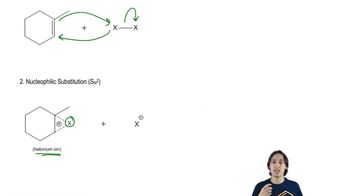
Halogenation

Halogenation is a chemical reaction where halogens (like bromine) are added to a compound. In the case of converting hex-1-yne to 2-bromohexane, the triple bond can be converted to a double bond through partial hydrogenation, followed by the addition of bromine. This process is essential for introducing halogen substituents into organic molecules.
추천 영상:
가이드 코스
03:45
Halogenation Mechanism

Markovnikov's Rule

Markovnikov's Rule states that in the addition of HX (where X is a halogen) to an alkene, the hydrogen atom will attach to the carbon with the greater number of hydrogen atoms already attached. This principle helps predict the regioselectivity of the reaction, guiding the formation of 2-bromohexane from hex-1-yne by favoring the more stable carbocation during the reaction.
추천 영상:
가이드 코스
03:54
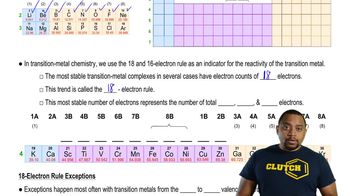
The 18 and 16 Electron Rule