Ch.9 - Alkynes
Wade - Organic Chemistry 9th Edition
Wade9th EditionOrganic ChemistryISBN: 9780135213728당신이 사용하는 게 아니라요?교과서 변경
9장, 문제 34a

Show how you would accomplish the following synthetic transformations. Show all intermediates.
a. 2,2-dibromobutane → but-1-yne

검증된 단계별 안내
1
Step 1: Analyze the starting material, 2,2-dibromobutane. This compound has two bromine atoms attached to the second carbon of a butane chain. The goal is to convert this into but-1-yne, which is an alkyne with a triple bond between the first and second carbons.
Step 2: Recognize that the transformation involves elimination reactions to remove the bromine atoms and form the triple bond. Use a strong base, such as sodium amide (NaNH₂), which is commonly used for dehydrohalogenation reactions to form alkynes.
Step 3: Perform the first elimination reaction. Treat 2,2-dibromobutane with a strong base to remove one bromine atom and a hydrogen atom from adjacent carbons, forming a double bond. This intermediate is 2-bromobut-1-ene.
Step 4: Perform the second elimination reaction. Treat the intermediate (2-bromobut-1-ene) with excess strong base to remove the remaining bromine atom and a hydrogen atom from adjacent carbons, forming the triple bond. This results in the formation of but-1-yne.
Step 5: Confirm the product structure. But-1-yne has a terminal triple bond between the first and second carbons, and no bromine atoms remain in the molecule. Ensure the reaction conditions are optimized to prevent side reactions or over-elimination.

비슷한 문제에 대한 검증된 영상 답변:

이 영상 해법은 위 문제에 도움이 된다고 튜터들이 추천한 것입니다.
영상 길이:
8m
도움이 되었나요?

주요 개념

질문에 올바르게 답하기 위해 반드시 이해해야 하는 핵심 개념들은 다음과 같습니다.

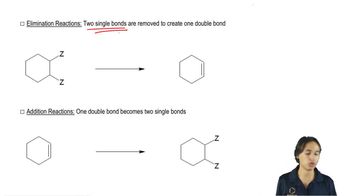
Elimination Reactions

Elimination reactions involve the removal of atoms or groups from a molecule, resulting in the formation of a double or triple bond. In the transformation from 2,2-dibromobutane to but-1-yne, a key step is the elimination of bromine atoms, which can be achieved through dehydrohalogenation using a strong base. Understanding the mechanism of elimination is crucial for predicting the formation of the alkyne product.
추천 영상:
00:40
Recognizing Elimination Reactions.

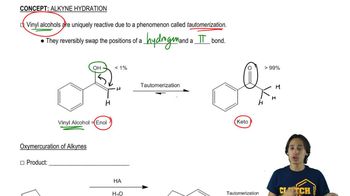
Alkyne Formation

Alkynes are hydrocarbons that contain at least one carbon-carbon triple bond. The synthesis of but-1-yne from 2,2-dibromobutane requires the formation of this triple bond through successive eliminations. Recognizing the structural requirements and stability of alkynes is essential for successfully completing the synthetic pathway.
추천 영상:
09:11
Alkyne Hydration

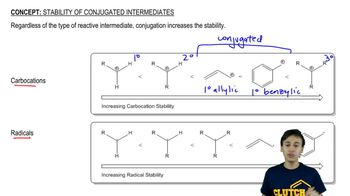
Reaction Intermediates

Reaction intermediates are transient species formed during the conversion of reactants to products in a chemical reaction. In the case of converting 2,2-dibromobutane to but-1-yne, intermediates such as alkenes may form before the final alkyne product is achieved. Identifying and illustrating these intermediates is important for understanding the stepwise progression of the synthesis.
추천 영상:
04:31
Stability of Conjugated Intermediates