Ch.9 - Alkynes
Wade - Organic Chemistry 9th Edition
Wade9th EditionOrganic ChemistryISBN: 9780135213728당신이 사용하는 게 아니라요?교과서 변경
9장, 문제 34b

Show how you would accomplish the following synthetic transformations. Show all intermediates.
b. 2,2-dibromobutane → but-2-yne

검증된 단계별 안내
1
Step 1: Analyze the starting material, 2,2-dibromobutane. This molecule contains two bromine atoms attached to the second carbon of a butane chain. The goal is to convert this into but-2-yne, which is an alkyne with a triple bond between carbons 2 and 3.
Step 2: Recognize that the transformation involves elimination reactions to remove the bromine atoms and form the triple bond. This typically requires a strong base to facilitate the elimination process.
Step 3: Use a strong base such as sodium amide (NaNH₂) in liquid ammonia (NH₃) to perform a double elimination. The first elimination removes one bromine atom and a hydrogen atom from adjacent carbons, forming a double bond (but-2-ene).
Step 4: The second elimination removes the remaining bromine atom and another hydrogen atom from adjacent carbons, converting the double bond into a triple bond, resulting in but-2-yne.
Step 5: Ensure proper reaction conditions, such as using excess base and maintaining a low temperature, to favor the formation of the alkyne and prevent side reactions.

비슷한 문제에 대한 검증된 영상 답변:

이 영상 해법은 위 문제에 도움이 된다고 튜터들이 추천한 것입니다.
영상 길이:
6m

주요 개념

질문에 올바르게 답하기 위해 반드시 이해해야 하는 핵심 개념들은 다음과 같습니다.

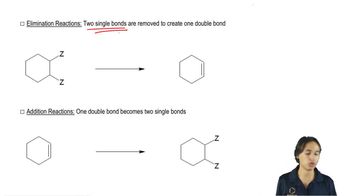
Elimination Reactions

Elimination reactions involve the removal of atoms or groups from a molecule, resulting in the formation of a double or triple bond. In the transformation from 2,2-dibromobutane to but-2-yne, a key step is the elimination of bromine atoms, which can be achieved through dehydrohalogenation. Understanding the mechanism of elimination reactions, including E2 and E1 pathways, is essential for predicting the formation of alkynes.
추천 영상:
00:40
Recognizing Elimination Reactions.

Alkyne Formation

The formation of alkynes typically involves the dehydrohalogenation of dihaloalkanes or the coupling of alkynes through various synthetic routes. In this case, converting 2,2-dibromobutane to but-2-yne requires the removal of two bromine atoms and the formation of a triple bond. Recognizing the conditions and reagents that favor alkyne formation is crucial for successfully completing the transformation.
추천 영상:
09:11
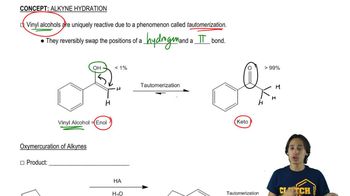
Alkyne Hydration

Reaction Mechanisms

Understanding reaction mechanisms is vital for predicting the steps involved in a chemical transformation. For the conversion of 2,2-dibromobutane to but-2-yne, one must consider the sequence of bond-breaking and bond-forming events, including the formation of intermediates such as alkenes. A clear grasp of mechanisms helps in visualizing the pathway and intermediates leading to the final product.
추천 영상:
02:16
Heck Reaction Mechanism