Ch.9 - Alkynes
Wade - Organic Chemistry 9th Edition
Wade9th EditionOrganic ChemistryISBN: 9780135213728당신이 사용하는 게 아니라요?교과서 변경
9장, 문제 41c

The following functional-group interchange is a useful synthesis of aldehydes.
Reaction diagram showing the conversion of a terminal alkyne to an aldehyde with structural formulas labeled.
(c) Explain why a nucleophilic reagent such as ethoxide adds to an alkyne more easily than it adds to an alkene.

검증된 단계별 안내
1
Step 1: Recognize the structural difference between alkynes and alkenes. Alkynes contain a triple bond (C≡C), while alkenes contain a double bond (C=C). The triple bond in alkynes is more polarized due to the higher s-character of the sp-hybridized carbon atoms, making the π-electrons more accessible to nucleophiles.
Step 2: Understand the role of ethoxide (CH3CH2O−) as a nucleophile. Ethoxide is negatively charged and seeks regions of electron deficiency. The terminal alkyne (R-C≡C-H) has a hydrogen atom attached to the sp-hybridized carbon, which is more acidic compared to the hydrogen on an alkene due to the increased electronegativity of the sp-hybridized carbon.
Step 3: Explain why nucleophilic addition is easier for alkynes. The increased acidity of the terminal alkyne allows the formation of an acetylide ion (R-C≡C−) upon deprotonation by ethoxide. This acetylide ion is highly nucleophilic and can readily react with electrophiles, facilitating addition reactions.
Step 4: Compare this behavior to alkenes. Alkenes are less acidic because their sp2-hybridized carbons have lower electronegativity compared to sp-hybridized carbons. This makes it harder for ethoxide to deprotonate an alkene and initiate nucleophilic addition.
Step 5: Relate this to the synthesis of aldehydes. The nucleophilic addition of ethoxide to the terminal alkyne sets the stage for subsequent reactions that convert the alkyne into an aldehyde, as shown in the provided image. This transformation leverages the unique reactivity of alkynes compared to alkenes.

비슷한 문제에 대한 검증된 영상 답변:

이 영상 해법은 위 문제에 도움이 된다고 튜터들이 추천한 것입니다.
영상 길이:
2m
도움이 되었나요?

주요 개념

질문에 올바르게 답하기 위해 반드시 이해해야 하는 핵심 개념들은 다음과 같습니다.

Nucleophilicity

Nucleophilicity refers to the ability of a nucleophile to donate an electron pair to an electrophile. In organic reactions, nucleophiles are species that are attracted to positively charged or electron-deficient centers. Ethoxide, being a strong nucleophile, can effectively attack electrophilic sites, such as those found in alkynes, due to their higher electron density compared to alkenes.
추천 영상:
08:27
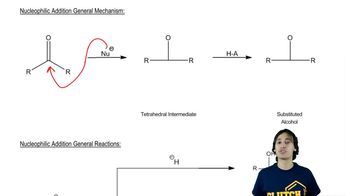
Nucleophilic Addition

Alkynes vs. Alkenes

Alkynes are hydrocarbons that contain at least one carbon-carbon triple bond, while alkenes contain a carbon-carbon double bond. The triple bond in alkynes is more reactive than the double bond in alkenes because it has a higher degree of electron density and can stabilize additional negative charge better, making them more susceptible to nucleophilic attack.
추천 영상:
01:55
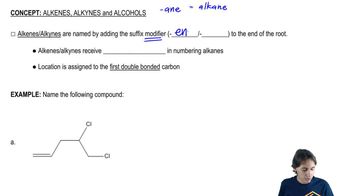
How to name alkenes and alkynes

Electrophilic Sites

Electrophilic sites are regions in a molecule that are electron-deficient and can accept electron pairs from nucleophiles. In the context of alkynes and alkenes, the sp-hybridized carbon in alkynes is more electronegative than the sp2-hybridized carbon in alkenes, making the former a more favorable site for nucleophilic addition due to its greater ability to stabilize the resulting negative charge.
추천 영상:
03:
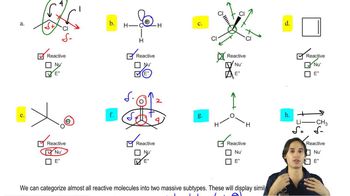
Nucleophile or Electrophile