


Ch.9 - Alkynes
Wade - Organic Chemistry 9th Edition
Wade9th EditionOrganic ChemistryISBN: 9780135213728당신이 사용하는 게 아니라요?교과서 변경
9장, 문제 39

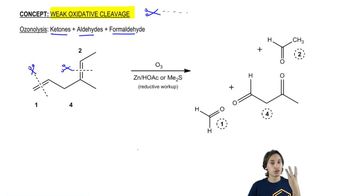
When compound Z is treated with ozone, followed by dimethyl sulfide and washing with water, the products are formic acid, 3-oxobutanoic acid, and hexanal.

Propose a structure for compound Z. What uncertainty is there in the structure you have proposed?

검증된 단계별 안내
1
Step 1: Analyze the reaction conditions. The reaction involves ozonolysis, which cleaves double bonds in alkenes to form carbonyl compounds. The use of ozone (O₃) followed by dimethyl sulfide ((CH₃)₂S) indicates reductive ozonolysis, which produces aldehydes and ketones.
Step 2: Examine the products formed. The products are formic acid (HCOOH), 3-oxobutanoic acid (CH₃COCH₂COOH), and hexanal (CH₃(CH₂)₄CHO). These products suggest that compound Z contains multiple double bonds that are cleaved during ozonolysis.
Step 3: Deduce the structure of compound Z. To form these products, compound Z must have a structure where the double bonds are positioned such that cleavage results in the observed products. Specifically, the double bonds must be located to yield formic acid, 3-oxobutanoic acid, and hexanal upon cleavage.
Step 4: Propose a possible structure for compound Z. Based on the products, compound Z could be a polyunsaturated compound with double bonds at specific positions. For example, Z might be a molecule with the structure CH₂=CH-CH₂-CH=CH-(CH₂)₄-CH=CH₂, where ozonolysis cleaves the double bonds to yield the observed products.
Step 5: Address uncertainty in the proposed structure. The exact positions of the double bonds in compound Z may vary slightly, as the reaction conditions and steric factors could influence the cleavage pattern. Additional experimental data, such as NMR or IR spectroscopy, would be needed to confirm the precise structure of Z.

비슷한 문제에 대한 검증된 영상 답변:

이 영상 해법은 위 문제에 도움이 된다고 튜터들이 추천한 것입니다.
영상 길이:
10m
도움이 되었나요?

주요 개념

질문에 올바르게 답하기 위해 반드시 이해해야 하는 핵심 개념들은 다음과 같습니다.

Ozonolysis

Ozonolysis is a reaction involving the cleavage of alkenes or alkynes using ozone (O3) to form carbonyl compounds. In this process, the double or triple bond is oxidatively cleaved, resulting in the formation of aldehydes, ketones, or carboxylic acids, depending on the structure of the starting material. The reaction typically proceeds in two steps: initial formation of ozonides followed by reduction, often using dimethyl sulfide (DMS) or zinc.
추천 영상:
06:30
General properties of ozonolysis.

Functional Group Identification

Identifying functional groups is crucial in organic chemistry as they determine the chemical reactivity and properties of compounds. In the context of the products formed from ozonolysis, recognizing functional groups such as aldehydes, ketones, and carboxylic acids helps in deducing the structure of the original compound Z. Each functional group has distinct characteristics that influence the overall behavior of the molecule.
추천 영상:
02:36
Identifying Functional Groups

Structural Ambiguity

Structural ambiguity arises when multiple structures can explain the same set of products or reactions. In the case of compound Z, the formation of formic acid, 3-oxobutanoic acid, and hexanal suggests that several different structures could lead to these products through ozonolysis. This uncertainty necessitates careful consideration of possible isomers and the arrangement of atoms in the proposed structure to ensure all products are accounted for.
추천 영상:
03:04
Drawing Resonance Structures
관련 실천
교과서 질문

When treated with hydrogen and a platinum catalyst, an unknown compound X absorbs 5 equivalents of hydrogen to give n-butylcyclohexane. Treatment of X with an excess of ozone, followed by dimethyl sulfide and water, gives the following products:

Propose a structure for the unknown compound X. Is there any uncertainty in your structure?

1486
views
교과서 질문

The following functional-group interchange is a useful synthesis of aldehydes.

(c) Explain why a nucleophilic reagent such as ethoxide adds to an alkyne more easily than it adds to an alkene.

743
views
교과서 질문

Show how you would synthesize the following compounds, starting with acetylene and any compounds containing no more than four carbon atoms.

d. trans-hex-2-ene

e. 1,1-dibromohexane

f. 2,2-dibromohexane

1711
views
교과서 질문

Show how you would convert the following starting materials into the target compound. You may use any additional reagents you need.

1085
views
교과서 질문

The following functional-group interchange is a useful synthesis of aldehydes.

(a) What reagents were used in this chapter for this transformation? Give an example to illustrate this method.

(b) This functional-group interchange can also be accomplished using the following sequence.

Propose mechanisms for these steps.

667
views
교과서 질문

Show how you would synthesize the following compounds, starting with acetylene and any compounds containing no more than four carbon atoms.

g. pentanal, CH3CH2CH2CH2CHO

h. pentan-2-one, CH3–CO–CH2CH2CH3

i. (±) 3,4-dibromohexane

1469
views