Ch.9 - Alkynes
Wade - Organic Chemistry 9th Edition
Wade9th EditionOrganic ChemistryISBN: 9780135213728당신이 사용하는 게 아니라요?교과서 변경
9장, 문제 10

When 2,2-dibromo-1-phenylpropane is heated overnight in fused KOH at 200 C, the major product is a foul-smelling compound of formula C9H8. Propose a structure for this product, and give a mechanism to account for its formation.
Problem-Solving Hint:
Reaction scheme showing formation of alkenes and alkynes from 2,2-dibromo-1-phenylpropane.

검증된 단계별 안내
1
Step 1: Analyze the given compound, 2,2-dibromo-1-phenylpropane. The presence of two bromine atoms on the same carbon suggests that elimination reactions can occur to form a triple bond (alkyne).
Step 2: Recognize the reaction conditions. Fused KOH at 200 °C is a strong base and high temperature promotes elimination reactions. This setup favors the formation of the most stable internal alkyne.
Step 3: Propose the mechanism. The reaction proceeds via a double dehydrohalogenation mechanism. First, KOH abstracts a proton from the carbon adjacent to the bromine atoms, leading to the formation of a carbanion. This carbanion eliminates a bromide ion, forming a double bond. The process repeats to eliminate the second bromine atom, resulting in the formation of a triple bond.
Step 4: Determine the major product. The most stable internal alkyne is formed due to the conjugation with the phenyl group. The product has the formula C9H8, which corresponds to phenylacetylene (C6H5-C≡CH).
Step 5: Explain the foul smell. Phenylacetylene is known to have a strong, unpleasant odor, consistent with the description in the problem.

비슷한 문제에 대한 검증된 영상 답변:

이 영상 해법은 위 문제에 도움이 된다고 튜터들이 추천한 것입니다.
영상 길이:
4m

주요 개념

질문에 올바르게 답하기 위해 반드시 이해해야 하는 핵심 개념들은 다음과 같습니다.

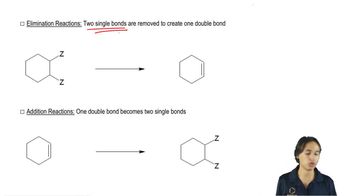
Elimination Reactions

Elimination reactions involve the removal of atoms or groups from a molecule, resulting in the formation of a double or triple bond. In the case of 2,2-dibromo-1-phenylpropane, heating with KOH promotes the elimination of bromine atoms, leading to the formation of alkenes or alkynes. Understanding the mechanism of elimination is crucial for predicting the structure of the product formed.
추천 영상:
00:40
Recognizing Elimination Reactions.

Alkyne Stability

Alkynes can be classified as terminal or internal based on the position of the triple bond. Internal alkynes, which have the triple bond between two carbon atoms, are generally more stable than terminal alkynes, which have the triple bond at the end of the carbon chain. The stability influences the product distribution in elimination reactions, making it essential to consider when predicting the major product.
추천 영상:
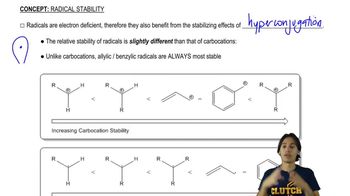
03:43
The radical stability trend.

Mechanism of Dehydrohalogenation

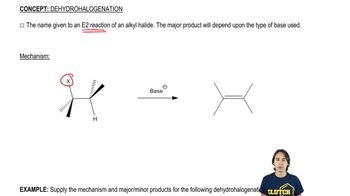
Dehydrohalogenation is a specific type of elimination reaction where a hydrogen halide is removed from a haloalkane, resulting in the formation of alkenes or alkynes. The mechanism typically involves the formation of a double bond through the loss of a halogen and a hydrogen atom. In this case, the mechanism helps explain how the foul-smelling compound C9H8 is formed from 2,2-dibromo-1-phenylpropane under the reaction conditions provided.
추천 영상:
03:02
The dehydrohalogenation mechanism.