Ch.9 - Alkynes
Wade - Organic Chemistry 9th Edition
Wade9th EditionOrganic ChemistryISBN: 9780135213728당신이 사용하는 게 아니라요?교과서 변경
9장, 문제 11

When 2,2-dibromo-1-phenylpropane is heated overnight with sodium amide at 150°C, the major product (after addition of water) is a different foul-smelling compound of formula C9H8. Propose a structure for this product, and give a mechanism to account for its formation.

검증된 단계별 안내
1
Identify the starting material: The compound 2,2-dibromo-1-phenylpropane has a phenyl group (C6H5-) attached to a propane chain with two bromine atoms on the same carbon (C2). Its structure is: C6H5-CH(CBr2)-CH3.
Analyze the reaction conditions: Sodium amide (NaNH2) is a strong base and nucleophile, and heating at 150 °C suggests an elimination reaction. The addition of water at the end indicates that the reaction involves deprotonation and possibly the formation of a reactive intermediate.
Propose the mechanism: Sodium amide abstracts a proton from the methyl group (CH3) adjacent to the dibromo carbon, forming a carbanion. This carbanion undergoes elimination of two bromine atoms (via two successive E2 eliminations), leading to the formation of a triple bond (alkyne) between the two carbons.
Determine the product structure: After the elimination of HBr twice, the resulting compound is phenylacetylene (C6H5-C≡CH), which matches the molecular formula C9H8. This compound is known to have a foul smell.
Summarize the mechanism: The reaction proceeds via a double dehydrohalogenation mechanism (E2 elimination) facilitated by the strong base (NaNH2), followed by the addition of water to neutralize any remaining reactive intermediates, yielding phenylacetylene as the final product.

비슷한 문제에 대한 검증된 영상 답변:

이 영상 해법은 위 문제에 도움이 된다고 튜터들이 추천한 것입니다.
영상 길이:
3m
도움이 되었나요?

주요 개념

질문에 올바르게 답하기 위해 반드시 이해해야 하는 핵심 개념들은 다음과 같습니다.

Elimination Reactions

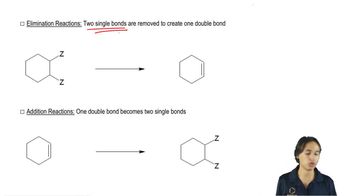
Elimination reactions involve the removal of atoms or groups from a molecule, resulting in the formation of a double bond. In the context of heating 2,2-dibromo-1-phenylpropane with sodium amide, a dehydrohalogenation process occurs, where bromine atoms are eliminated, leading to the formation of an alkene. Understanding this mechanism is crucial for predicting the structure of the final product.
추천 영상:
00:40
Recognizing Elimination Reactions.

Nucleophilic Substitution

Nucleophilic substitution is a fundamental reaction in organic chemistry where a nucleophile replaces a leaving group in a molecule. In this case, sodium amide acts as a strong nucleophile, facilitating the substitution of bromine atoms in 2,2-dibromo-1-phenylpropane. This concept is essential for understanding how the initial compound transforms into the foul-smelling product.
추천 영상:
01:47
Nucleophiles and Electrophiles can react in Substitution Reactions.

Aromatic Compounds

Aromatic compounds are cyclic structures that follow Huckel's rule, exhibiting resonance and stability due to delocalized pi electrons. The product of the reaction is likely to contain an aromatic ring, which contributes to its distinct properties, including its foul smell. Recognizing the role of aromaticity helps in predicting the characteristics and stability of the final compound formed from the reaction.
추천 영상:
08:19
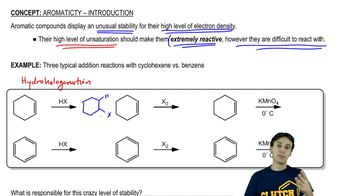
Intro to Aromaticity