Ch.6 - Alkyl Halides; Nucleophilic Substitution
Wade - Organic Chemistry 9th Edition
Wade9th EditionOrganic ChemistryISBN: 9780135213728당신이 사용하는 게 아니라요?교과서 변경
6장, 문제 59a

A student adds NBS to a solution of 1-methylcyclohexene and irradiates the mixture with a sunlamp until all the NBS has reacted. After a careful distillation, the product mixture contains two major products of formula C7H11Br.
a. Draw the resonance forms of the three possible allylic free radical intermediates.

검증된 단계별 안내
1
Step 1: Understand the reaction mechanism. NBS (N-Bromosuccinimide) is commonly used for allylic bromination in the presence of light or heat. The reaction proceeds via a free radical mechanism, where the allylic hydrogen is abstracted, forming an allylic radical intermediate.
Step 2: Identify the allylic positions in 1-methylcyclohexene. The allylic position is the carbon atom adjacent to the double bond. In 1-methylcyclohexene, there are two distinct allylic positions: one on the methyl group and one on the cyclohexene ring.
Step 3: Draw the first allylic radical intermediate. When the hydrogen from the methyl group is abstracted, a resonance-stabilized allylic radical is formed. Use curved arrows to show the delocalization of the unpaired electron across the π-system of the double bond.
Step 4: Draw the second allylic radical intermediate. When the hydrogen from the cyclohexene ring is abstracted, another resonance-stabilized allylic radical is formed. Again, use curved arrows to show the delocalization of the unpaired electron across the π-system.
Step 5: Draw the third allylic radical intermediate. Consider the possibility of resonance structures for the second allylic radical. This involves shifting the double bond and the unpaired electron to generate an additional resonance form. Ensure all resonance forms are properly drawn and labeled.

비슷한 문제에 대한 검증된 영상 답변:

이 영상 해법은 위 문제에 도움이 된다고 튜터들이 추천한 것입니다.
영상 길이:
5m

주요 개념

질문에 올바르게 답하기 위해 반드시 이해해야 하는 핵심 개념들은 다음과 같습니다.

Allylic Free Radicals

Allylic free radicals are reactive intermediates formed when a radical is located on a carbon atom adjacent to a double bond. These radicals are stabilized by resonance, allowing the unpaired electron to be delocalized over the π system of the alkene. This delocalization increases the stability of the radical, making it more favorable for reactions such as halogenation.
추천 영상:
03:28
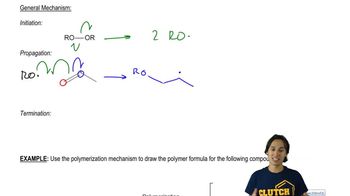
The mechanism of Radical Polymerization.

Resonance Structures

Resonance structures are different Lewis structures for the same molecule that illustrate the delocalization of electrons. In the case of allylic free radicals, resonance forms show how the radical can be represented at different positions along the carbon chain. These structures help predict the stability and reactivity of the radical, as well as the possible products formed during reactions.
추천 영상:
03:04
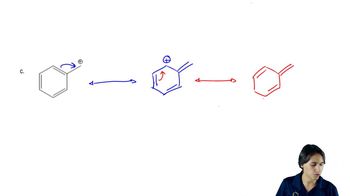
Drawing Resonance Structures

N-Bromosuccinimide (NBS) and its Role

N-Bromosuccinimide (NBS) is a reagent commonly used in organic chemistry for bromination reactions, particularly in allylic positions. When NBS is added to alkenes, it generates bromine radicals under light irradiation, which can abstract hydrogen atoms from the allylic position, forming allylic free radicals. This process leads to the formation of brominated products, which are crucial for understanding the reaction mechanism and product distribution.
추천 영상:
04:31
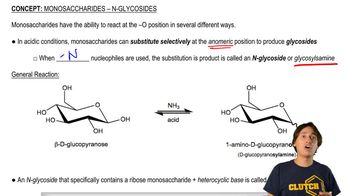
General Reaction