
Ch.6 - Alkyl Halides; Nucleophilic Substitution
Wade - Organic Chemistry 9th Edition
Wade9th EditionOrganic ChemistryISBN: 9780135213728당신이 사용하는 게 아니라요?교과서 변경
6장, 문제 58a,b

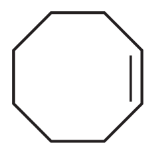
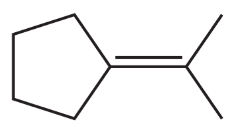
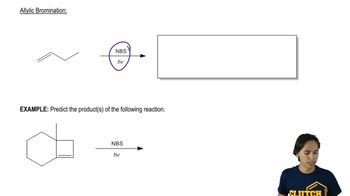
Show the products you expect when each compound reacts with NBS with light shining on the reaction.
(a)
(b)

검증된 단계별 안내
1
Step 1: Recognize that NBS (N-Bromosuccinimide) in the presence of light is used for allylic or benzylic bromination. This reaction selectively replaces a hydrogen atom at the allylic or benzylic position with a bromine atom.
Step 2: For compound (a), identify the allylic positions. The double bond in the cyclic structure creates allylic positions adjacent to the double bond. These are the carbons directly connected to the double bond but not part of it.
Step 3: For compound (a), determine the most stable allylic radical that can form after the abstraction of a hydrogen atom by the bromine radical. Stability is influenced by resonance structures, so consider all possible resonance forms.
Step 4: For compound (b), identify the allylic positions near the double bond in the bicyclic structure. Similar to compound (a), these are the carbons adjacent to the double bond but not part of it.
Step 5: For compound (b), determine the most stable allylic radical that can form after hydrogen abstraction. Again, consider resonance stabilization. Once the radical is formed, bromine will attach to the allylic position, yielding the brominated product.

비슷한 문제에 대한 검증된 영상 답변:

이 영상 해법은 위 문제에 도움이 된다고 튜터들이 추천한 것입니다.
영상 길이:
2m

주요 개념

질문에 올바르게 답하기 위해 반드시 이해해야 하는 핵심 개념들은 다음과 같습니다.

NBS (N-Bromosuccinimide)

N-Bromosuccinimide (NBS) is a reagent commonly used in organic chemistry for bromination reactions, particularly in the presence of light. It generates bromine radicals upon photolysis, which can abstract hydrogen atoms from alkenes or alkanes, leading to the formation of brominated products. Understanding how NBS functions is crucial for predicting the products of reactions involving this reagent.
추천 영상:
가이드 코스
3:06
Synthesis of Amino Acids: N-Phthalimidomalonic Ester Synthesis Concept 1

Radical Mechanism

The radical mechanism involves the formation and reaction of free radicals, which are highly reactive species with unpaired electrons. In the context of NBS reactions, light initiates the generation of bromine radicals that can abstract hydrogen from substrates, resulting in the formation of alkyl radicals. These radicals can then react further to yield stable products, making it essential to understand radical stability and reactivity.
추천 영상:
03:28
The mechanism of Radical Polymerization.

Selectivity in Bromination

Selectivity in bromination refers to the preference of bromine radicals to abstract hydrogen from certain positions in a molecule, often influenced by the stability of the resulting radical. For example, tertiary radicals are more stable than secondary or primary ones, leading to preferential bromination at more substituted positions. Recognizing this selectivity is key to predicting the major products formed in reactions with NBS.
추천 영상:
00:54
Mechanism of Allylic Bromination.
관련 실천
교과서 질문

A student adds NBS to a solution of 1-methylcyclohexene and irradiates the mixture with a sunlamp until all the NBS has reacted. After a careful distillation, the product mixture contains two major products of formula C7H11Br.

a. Draw the resonance forms of the three possible allylic free radical intermediates.

2475
views
교과서 질문

Propose mechanisms to account for the observed products in the following reactions.

(b)

674
views
교과서 질문

Show the products you expect when each compound reacts with NBS with light shining on the reaction.

(c)

1253
views
교과서 질문

The following reaction takes place under second-order conditions (strong nucleophile), yet the structure of the product shows rearrangement. Also, the rate of this reaction is several thousand times faster than the rate of substitution of ­hydroxide ion on 2-chlorobutane under similar conditions. Propose a mechanism to explain the enhanced rate and ­rearrangement observed in this unusual reaction. (“Et” is the abbreviation for ethyl.)

659
views
교과서 질문

Propose mechanisms to account for the observed products in the following reactions.

(a)

936
views
교과서 질문

A student adds NBS to a solution of 1-methylcyclohexene and irradiates the mixture with a sunlamp until all the NBS has reacted. After a careful distillation, the product mixture contains two major products of formula C7H11Br.

(a) Draw the resonance forms of the three possible allylic free radical intermediates.

(b) Rank these three intermediates from most stable to least stable.

(c) Draw the products obtained from each free-radical intermediate.

948
views