Ch.6 - Alkyl Halides; Nucleophilic Substitution
Wade - Organic Chemistry 9th Edition
Wade9th EditionOrganic ChemistryISBN: 9780135213728당신이 사용하는 게 아니라요?교과서 변경
6장, 문제 28

Under certain conditions, when (R)-2-bromobutane is heated with water, the SN1 substitution proceeds twice as fast as the SN2. Calculate the e.e. and the specific rotation expected for the product. The specific rotation of (R)-butan-2-ol is −13.5°. Assume that the SN1 gives equal amounts of the two enantiomers.

검증된 단계별 안내
1
Step 1: Understand the reaction mechanism. The problem involves two substitution reactions: SN1 and SN2. SN1 proceeds via a carbocation intermediate and typically results in a racemic mixture due to the planar nature of the carbocation. SN2 proceeds via a backside attack, leading to inversion of configuration.
Step 2: Analyze the given data. The SN1 reaction produces equal amounts of the two enantiomers, meaning the product from SN1 is racemic and has no optical activity. The SN2 reaction produces only the (S)-enantiomer due to inversion of configuration.
Step 3: Determine the enantiomeric excess (e.e.). Enantiomeric excess is calculated using the formula: ee=%major-%minor%total. Since SN1 proceeds twice as fast as SN2, the ratio of SN1 to SN2 products is 2:1.
Step 4: Calculate the specific rotation of the product. The specific rotation of a mixture is calculated using the formula: [ heta]=%R−%S%total×[ heta]pure. Here, the specific rotation of (R)-butan-2-ol is given as −13.5°.
Step 5: Combine the results. Use the ratio of SN1 and SN2 products, the enantiomeric excess formula, and the specific rotation formula to calculate the e.e. and the specific rotation of the final product. Ensure to account for the racemic nature of the SN1 product and the optical activity of the SN2 product.

비슷한 문제에 대한 검증된 영상 답변:

이 영상 해법은 위 문제에 도움이 된다고 튜터들이 추천한 것입니다.
영상 길이:
5m

주요 개념

질문에 올바르게 답하기 위해 반드시 이해해야 하는 핵심 개념들은 다음과 같습니다.

SN1 and SN2 Mechanisms

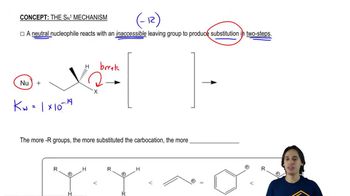
SN1 and SN2 are two fundamental types of nucleophilic substitution reactions in organic chemistry. SN1 reactions involve a two-step mechanism where the leaving group departs first, forming a carbocation intermediate, followed by nucleophilic attack. In contrast, SN2 reactions occur in a single concerted step where the nucleophile attacks the substrate simultaneously as the leaving group departs. Understanding these mechanisms is crucial for predicting reaction rates and stereochemical outcomes.
추천 영상:
10:49
Drawing the SN1 Mechanism

Enantiomers and Optical Activity

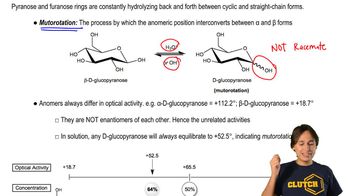
Enantiomers are pairs of molecules that are non-superimposable mirror images of each other, often differing in their optical activity. Each enantiomer rotates plane-polarized light in opposite directions, measured as specific rotation. The concept of enantiomers is essential for calculating enantiomeric excess (e.e.), which quantifies the purity of one enantiomer over the other in a mixture, influencing the overall optical activity of the product.
추천 영상:
08:17
Mutorotation and Optical Activity

Specific Rotation Calculation

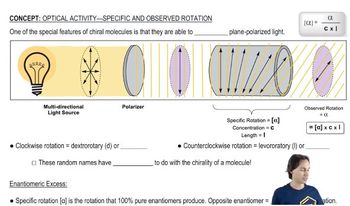
Specific rotation is a property of chiral compounds that quantifies their ability to rotate plane-polarized light, expressed as [α] = α / (c × l), where α is the observed rotation, c is the concentration in g/mL, and l is the path length in decimeters. In this context, calculating the specific rotation of the product involves considering the contributions from both enantiomers produced in the reaction, particularly when the SN1 mechanism yields equal amounts of each enantiomer.
추천 영상:
05:43
Specific rotation vs. observed rotation.
관련 실천
교과서 질문

For each reaction, give the expected substitution product, and predict whether the ­mechanism will be predominantly first order (SN1) or second order (SN2).

a. 2-chloro-2-methylbutane + CH3COOH

b. isobutylbromide + sodium methoxide

819
views

교과서 질문

A reluctant first-order substrate can be forced to ionize by adding some silver nitrate (one of the few soluble silver salts) to the reaction. Silver ion reacts with the halogen to form a silver halide (a highly exothermic reaction), generating the cation of the alkyl group.

Give mechanisms for the following silver-promoted rearrangements.

(b)

741
views
교과서 질문

For each reaction, give the expected substitution product, and predict whether the ­mechanism will be predominantly first order (SN1) or second order (SN2).

d. cyclohexylbromide + methanol

e. cyclohexylbromide + sodium ethoxide

1574
views
교과서 질문

Show how you would convert (in one or two steps) 1-phenylpropane to the three products shown below. In each case, explain what unwanted reactions might produce undesirable impurities in the product.

1009
views
교과서 질문

A reluctant first-order substrate can be forced to ionize by adding some silver nitrate (one of the few soluble silver salts) to the reaction. Silver ion reacts with the halogen to form a silver halide (a highly exothermic reaction), generating the cation of the alkyl group.

Give mechanisms for the following silver-promoted rearrangements.

(a)

1853
views
교과서 질문

For each reaction, give the expected substitution product, and predict whether the ­mechanism will be predominantly first order (SN1) or second order (SN2).

c. 1-iodo-1-methylcyclohexane + ethanol

763
views