Ch.6 - Alkyl Halides; Nucleophilic Substitution
Wade - Organic Chemistry 9th Edition
Wade9th EditionOrganic ChemistryISBN: 9780135213728당신이 사용하는 게 아니라요?교과서 변경
6장, 문제 30b

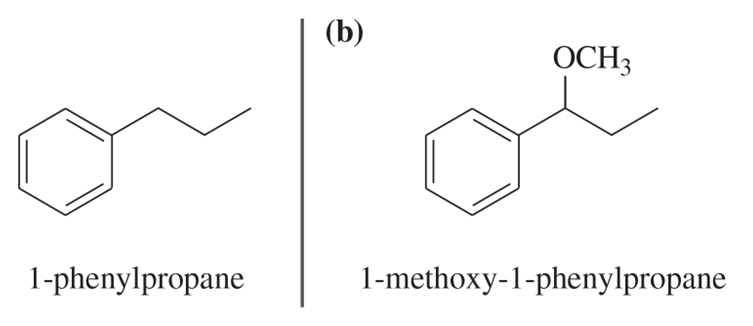
Show how you would convert (in one or two steps) 1-phenylpropane to the three products shown below. In each case, explain what unwanted reactions might produce undesirable impurities in the product.

검증된 단계별 안내
1
Step 1: To convert 1-phenylpropane to 1-methoxy-1-phenylpropane, begin by introducing a nucleophilic substitution reaction. First, oxidize the benzylic position (the carbon attached to the phenyl group) to form 1-phenylpropan-1-ol. This can be achieved using reagents like sodium dichromate (Na2Cr2O7) or PCC (Pyridinium chlorochromate) under controlled conditions.
Step 2: Once the alcohol group (-OH) is formed at the benzylic position, perform a Williamson ether synthesis to introduce the methoxy group (-OCH3). React the alcohol with sodium methoxide (NaOCH3) or methanol in the presence of an acid catalyst like H2SO4 to form 1-methoxy-1-phenylpropane.
Step 3: Consider potential side reactions. During the oxidation step, overoxidation to a carboxylic acid (benzoic acid derivative) might occur if the reaction conditions are not carefully controlled. To avoid this, use mild oxidizing agents and monitor the reaction closely.
Step 4: During the etherification step, unwanted reactions such as elimination (forming alkenes) or competing nucleophilic substitution reactions might occur. Ensure the reaction conditions favor ether formation by using an excess of methanol and maintaining a low temperature.
Step 5: Purify the final product using techniques like distillation or chromatography to separate the desired 1-methoxy-1-phenylpropane from any impurities or side products formed during the reaction.

비슷한 문제에 대한 검증된 영상 답변:

이 영상 해법은 위 문제에 도움이 된다고 튜터들이 추천한 것입니다.
영상 길이:
3m

주요 개념

질문에 올바르게 답하기 위해 반드시 이해해야 하는 핵심 개념들은 다음과 같습니다.

Nucleophilic Substitution

Nucleophilic substitution is a fundamental reaction in organic chemistry where a nucleophile attacks an electrophile, replacing a leaving group. In the context of converting 1-phenylpropane to 1-methoxy-1-phenylpropane, a nucleophile such as methanol can react with a suitable electrophile derived from 1-phenylpropane, leading to the desired product. Understanding this mechanism is crucial for predicting reaction pathways and potential side reactions.
추천 영상:
01:47
Nucleophiles and Electrophiles can react in Substitution Reactions.

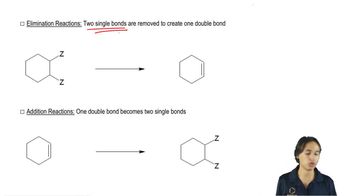
Elimination Reactions

Elimination reactions involve the removal of atoms or groups from a molecule, resulting in the formation of a double bond or a ring structure. In the conversion of 1-phenylpropane, unwanted elimination reactions could lead to the formation of alkenes or other byproducts, which may contaminate the desired product. Recognizing the conditions that favor elimination over substitution is essential for optimizing reaction outcomes.
추천 영상:
00:40
Recognizing Elimination Reactions.

Reaction Conditions and Selectivity

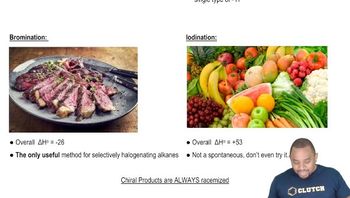
The conditions under which a reaction is carried out, such as temperature, solvent, and concentration, significantly influence the selectivity and yield of the desired product. In the case of synthesizing 1-methoxy-1-phenylpropane, controlling these parameters can minimize unwanted side reactions and impurities. A thorough understanding of how reaction conditions affect selectivity is vital for successful organic synthesis.
추천 영상:
10:08
Radical selectivity: Food Analogy
관련 실천
교과서 질문

Predict the compound in each pair that will undergo the SN2 reaction faster.

(a)

(b)

2349
views

교과서 질문

A reluctant first-order substrate can be forced to ionize by adding some silver nitrate (one of the few soluble silver salts) to the reaction. Silver ion reacts with the halogen to form a silver halide (a highly exothermic reaction), generating the cation of the alkyl group.

Give mechanisms for the following silver-promoted rearrangements.

(b)

741
views
교과서 질문

Show how you would convert (in one or two steps) 1-phenylpropane to the three products shown below. In each case, explain what unwanted reactions might produce undesirable impurities in the product.

744
views
교과서 질문

Under certain conditions, when (R)-2-bromobutane is heated with water, the SN1 substitution proceeds twice as fast as the SN2. Calculate the e.e. and the specific rotation expected for the product. The specific rotation of (R)-butan-2-ol is −13.5°. Assume that the SN1 gives equal amounts of the two enantiomers.

1242
views
교과서 질문

Draw the structures of the following compounds.

a. sec-butyl chloride

b. isobutyl bromide

864
views
교과서 질문

A reluctant first-order substrate can be forced to ionize by adding some silver nitrate (one of the few soluble silver salts) to the reaction. Silver ion reacts with the halogen to form a silver halide (a highly exothermic reaction), generating the cation of the alkyl group.

Give mechanisms for the following silver-promoted rearrangements.

(a)

1853
views