Ch.6 - Alkyl Halides; Nucleophilic Substitution
Wade - Organic Chemistry 9th Edition
Wade9th EditionOrganic ChemistryISBN: 9780135213728당신이 사용하는 게 아니라요?교과서 변경
6장, 문제 46 a

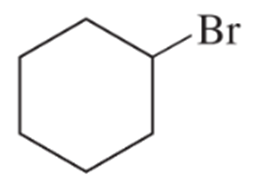
Using cyclohexane as one of your starting materials, show how you would synthesize the following compounds.
(a)

검증된 단계별 안내
1
Step 1: Begin with cyclohexane as the starting material. Cyclohexane is a saturated hydrocarbon with the molecular formula C6H12.
Step 2: To introduce a bromine atom onto the cyclohexane ring, perform a free radical halogenation reaction. This reaction typically requires the presence of bromine (Br2) and a source of UV light or heat to initiate the formation of bromine radicals.
Step 3: The bromine radicals generated will abstract a hydrogen atom from cyclohexane, forming a cyclohexyl radical. This radical will then react with another bromine molecule to form bromocyclohexane.
Step 4: Ensure that the reaction conditions are controlled to favor monobromination rather than polybromination. Excess bromine or prolonged reaction times can lead to multiple bromine atoms being added to the cyclohexane ring.
Step 5: Isolate and purify the bromocyclohexane product using techniques such as distillation or recrystallization, depending on the physical properties of the compound.

비슷한 문제에 대한 검증된 영상 답변:

이 영상 해법은 위 문제에 도움이 된다고 튜터들이 추천한 것입니다.
영상 길이:
1m

주요 개념

질문에 올바르게 답하기 위해 반드시 이해해야 하는 핵심 개념들은 다음과 같습니다.

Free Radical Halogenation

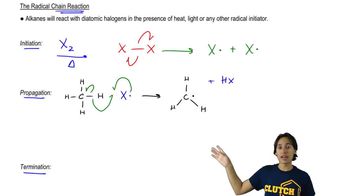
Free radical halogenation is a reaction where alkanes react with halogens (like bromine) in the presence of heat or light to form alkyl halides. The process involves the generation of free radicals, which are highly reactive species with unpaired electrons. In the case of cyclohexane, bromine can abstract a hydrogen atom, leading to the formation of bromocyclohexane.
추천 영상:
12:11
Radical Chain Reaction Mechanism.

Cyclohexane Structure

Cyclohexane is a six-membered carbon ring with the molecular formula C6H12. It is a saturated hydrocarbon, meaning it contains only single bonds between carbon atoms. The structure allows for various conformations, such as chair and boat forms, which influence its reactivity and interactions with other reagents during chemical reactions.
추천 영상:
03:04
Drawing Resonance Structures

Reaction Mechanism

Understanding the reaction mechanism is crucial for predicting the products of organic reactions. In free radical halogenation, the mechanism consists of three steps: initiation (formation of radicals), propagation (reaction of radicals with the substrate), and termination (recombination of radicals). Each step is essential for understanding how cyclohexane can be transformed into bromocyclohexane.
추천 영상:
02:16
Heck Reaction Mechanism