Ch.6 - Alkyl Halides; Nucleophilic Substitution
Wade - Organic Chemistry 9th Edition
Wade9th EditionOrganic ChemistryISBN: 9780135213728당신이 사용하는 게 아니라요?교과서 변경
6장, 문제 46e

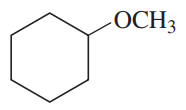
Using cyclohexane as one of your starting materials, show how you would synthesize the following compounds.
(e) Cyclohexane structure with a methoxy group (OCH3) attached, illustrating a radical reaction synthesis.

검증된 단계별 안내
1
Step 1: Begin with cyclohexane as the starting material. Cyclohexane is a saturated hydrocarbon with the molecular formula C6H12. To introduce a functional group, you need to activate one of the hydrogens on the ring.
Step 2: Perform a free radical halogenation reaction using bromine (Br2) and light (hv) or heat. This will replace one hydrogen atom on the cyclohexane ring with a bromine atom, forming bromocyclohexane.
Step 3: Prepare a nucleophile for substitution. Use methoxide ion (CH3O⁻), which can be generated from sodium methoxide (NaOCH3) in methanol. Methoxide is a strong nucleophile and will readily participate in a substitution reaction.
Step 4: Perform an SN2 reaction between bromocyclohexane and methoxide ion. The bromine atom will be replaced by the methoxy group (-OCH3), resulting in the formation of methoxycyclohexane.
Step 5: Purify the product using standard organic chemistry techniques such as distillation or recrystallization to isolate methoxycyclohexane.

비슷한 문제에 대한 검증된 영상 답변:

이 영상 해법은 위 문제에 도움이 된다고 튜터들이 추천한 것입니다.
영상 길이:
5m

주요 개념

질문에 올바르게 답하기 위해 반드시 이해해야 하는 핵심 개념들은 다음과 같습니다.

Cyclohexane Structure and Reactivity

Cyclohexane is a six-membered carbon ring that is saturated, meaning it contains only single bonds. Its stable chair conformation minimizes steric strain, making it a common starting material in organic synthesis. Understanding its structure is crucial for predicting how it will react in various chemical transformations, including substitution and radical reactions.
추천 영상:
01:17
Reactivity of Molecules

Radical Reactions

Radical reactions involve species with unpaired electrons, known as radicals, which can initiate chain reactions. In the context of synthesizing compounds from cyclohexane, radical halogenation can introduce functional groups like methoxy (OCH3) through the abstraction of hydrogen atoms. Mastery of radical mechanisms is essential for designing effective synthetic pathways.
추천 영상:
03:49
What are Radical Initiators?

Functional Group Transformation

Functional group transformation refers to the process of converting one functional group into another, which is a key aspect of organic synthesis. In this case, converting cyclohexane into a methoxy-substituted cyclohexane involves introducing an ether group. Understanding the reactivity and compatibility of different functional groups is vital for successful synthesis.
추천 영상:
02:36
Identifying Functional Groups
관련 실천
교과서 질문

Using cyclohexane as one of your starting materials, show how you would synthesize the following compounds.

(c)

662
views

교과서 질문

A solution of pure (S)-2-iodobutane ([α] = +15.90°) in acetone is allowed to react with radioactive iodide, 131I–, until 1.0% of the iodobutane contains radioactive iodine. The specific rotation of this recovered iodobutane is found to be +15.58°.

b. What does this result suggest about the mechanism of the reaction of 2-iodobutane with iodide ion?

671
views
교과서 질문

Predict the products of the following SN2 reactions.

(e)

(f)

2452
views
교과서 질문

A solution of pure (S)-2-iodobutane ([α] = +15.90°) in acetone is allowed to react with radioactive iodide, 131I–, until 1.0% of the iodobutane contains radioactive iodine. The specific rotation of this recovered iodobutane is found to be +15.58°.

a. Determine the percentages of (R)- and (S)-2-iodobutane in the product mixture.

853
views
교과서 질문

Using cyclohexane as one of your starting materials, show how you would synthesize the following compounds.

(a)

868
views
교과서 질문

Strawberry growers have used large quantities of methyl bromide (b.p. 4 °C) to sterilize the soil before planting their crops. Like some of the freons, methyl bromide can diffuse up into the stratosphere, where it damages the protective ozone layer. Agricultural chemists have suggested using methyl iodide (b.p. 43 °C) as a replacement for methyl bromide. Why is methyl iodide likely to be more toxic to agricultural pests (and people) than methyl bromide? Why is methyl iodide less likely to reach the stratosphere than methyl bromide?

1052
views