Back

Inactivated Vaccines definitions

Control buttons has been changed to "navigation" mode.
1/15
  • Inactivated Vaccine

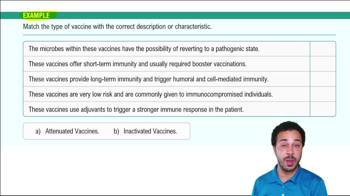
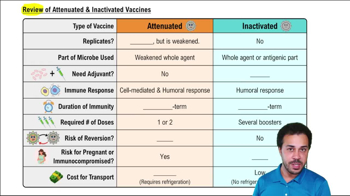
    A preparation containing a pathogen altered to prevent replication, providing short-term protection and primarily inducing humoral immunity.
  • Humoral Immunity

    A branch of adaptive immunity involving B cells and antibodies, typically stimulated by non-replicating immunizing agents.
  • Adjuvant

    A substance added to enhance the immune response to a vaccine, especially important when the immunizing agent cannot replicate.
  • Booster Dose

    An additional administration of a vaccine to maintain or increase immunity when initial protection wanes.
  • Whole Agent Vaccine

    A formulation containing the entire inactivated pathogen, rendered non-infectious by chemical or physical means.
  • Subunit Vaccine

    A preparation containing only specific antigenic parts of a pathogen, such as proteins or polysaccharides, to stimulate immunity.
  • Polysaccharide Vaccine

    A subunit vaccine using sugar molecules from a pathogen's capsule, often less effective in young children due to T-independent antigens.
  • Conjugate Vaccine

    A polysaccharide-based preparation linked to a protein, converting the antigen to T-dependent and improving effectiveness in young children.
  • Virus-Like Particle Vaccine

    A formulation using the empty outer shell of a virus, lacking genetic material, to safely induce an immune response.
  • Toxoid Vaccine

    A preparation containing inactivated bacterial toxins, designed to stimulate immunity without causing disease.
  • Recombinant Vaccine

    A vaccine produced using genetic engineering, where components are synthesized by non-pathogenic organisms.
  • Cell-Mediated Immunity

    A branch of adaptive immunity involving T cells, typically not strongly induced by non-replicating immunizing agents.
  • Pathogen Reversion

    The process by which a weakened microbe regains disease-causing ability, a risk absent in non-replicating preparations.
  • Antigen

    A molecule or molecular structure from a pathogen that triggers a specific immune response when introduced into the body.
  • Transport Cost

    The logistical expense associated with moving vaccines, generally lower for non-replicating preparations due to reduced refrigeration needs.