Back

Inactivated Vaccines quiz

Control buttons has been changed to "navigation" mode.
1/15
  • What is the main alteration made to pathogens in inactivated vaccines?

    Pathogens are chemically or physically altered so they cannot replicate within the host.
  • Why do inactivated vaccines typically require multiple booster doses?

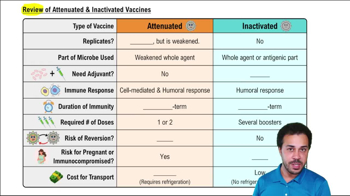
    Because they provide short-term protection due to the lack of immune amplification from replication.
  • What type of immunity do inactivated vaccines primarily induce?

    They primarily induce humoral immunity, leading to B cell and antibody responses.
  • Why are adjuvants often added to inactivated vaccines?

    Adjuvants are added to enhance the immune response since inactivated vaccines lack replication and immune amplification.
  • Are inactivated vaccines safe for pregnant and immunocompromised individuals, and why?

    Yes, because there is no risk of the vaccine reverting to a pathogenic state.
  • What are the two main categories of inactivated vaccines?

    They are whole agent vaccines and partial agent (subunit) vaccines.
  • How are whole agent inactivated vaccines typically produced?

    They use the entire inactivated pathogen, often treated with chemicals, heat, or radiation.
  • What distinguishes partial agent (subunit) vaccines from whole agent vaccines?

    Partial agent vaccines contain only a small portion of the pathogen, usually an antigenic protein.
  • What is a polysaccharide vaccine and its limitation in young children?

    It uses a polysaccharide from a pathogen capsule and is not effective in young kids because it is a T-independent antigen.
  • How do conjugate vaccines differ from polysaccharide vaccines?

    Conjugate vaccines link a polysaccharide to an antigenic protein, making them T-dependent and effective in young children.
  • What is a virus-like particle (VLP) vaccine?

    It uses antigens from the empty outer shell of a virus, lacking the virus's genetic material.
  • What is a toxoid vaccine?

    A toxoid vaccine uses inactivated bacterial toxins to stimulate the immune system.
  • What are recombinant vaccines and how are they produced?

    Recombinant vaccines use components produced by genetic engineering, such as antigens made by modified microbes.
  • Compared to attenuated vaccines, what is a key disadvantage of inactivated vaccines regarding immunity duration?

    Inactivated vaccines provide short-term immunity and require more booster doses, while attenuated vaccines often provide long-term or lifelong immunity.
  • Why do inactivated vaccines have lower transport costs than attenuated vaccines?

    They do not require refrigeration for storage and transport, making them less expensive to distribute.