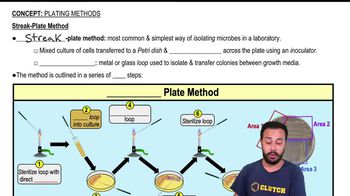
“In the laboratory, a sterile inoculating loop is moved across the agar surface in a culture dish, thinning a sample and isolating individuals.” This statement describes which of the following? a. Broth culture b. Pour plate c. Streak plate d. Dilution plate
Verified step by step guidance
1
Understand the purpose of the technique described: moving a sterile inoculating loop across the agar surface to thin out a sample and isolate individual colonies.
Recall that a broth culture involves growing microorganisms in a liquid nutrient medium, so it does not involve streaking on agar.
Recognize that a pour plate involves mixing the sample with molten agar and then pouring it into a petri dish, which is different from streaking on the surface.
Identify that a dilution plate involves spreading diluted samples on agar to reduce the number of colonies, but it typically uses a spreader rather than a loop streak.
Conclude that the described method matches the streak plate technique, which is used to isolate pure colonies by sequentially thinning the sample on the agar surface.
Verified video answer for a similar problem:
This video solution was recommended by our tutors as helpful for the problem above.
Video duration:
4m
Play a video:
Was this helpful?
Key Concepts
Here are the essential concepts you must grasp in order to answer the question correctly.
Streak Plate Method
The streak plate method is a microbiological technique used to isolate individual bacterial colonies by spreading a sample over the surface of an agar plate with a sterile loop. This process thins out the sample, allowing single cells to grow into separate colonies for identification.
Agar is a gelatinous substance derived from seaweed used as a solid culture medium in petri dishes. It provides a surface for microbial growth and allows for the physical separation of colonies when samples are spread or streaked on it.
Isolation involves separating individual microorganisms from a mixed sample to obtain pure cultures. Techniques like streak plating enable microbiologists to obtain discrete colonies, which are essential for studying specific microbial species.