Superoxide dismutase: a. Causes hydrogen peroxide to become toxic b. Detoxifies superoxide radicals c. Neutralizes singlet oxygen d. Is missing in aerobes
Verified step by step guidance
1
Understand the role of superoxide dismutase (SOD) in cellular metabolism, particularly in relation to reactive oxygen species (ROS).
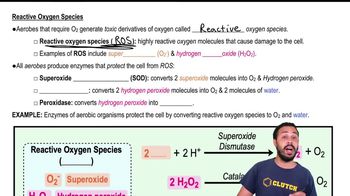
Recall that superoxide radicals (O2•−) are harmful byproducts of oxygen metabolism that can damage cellular components.
Recognize that superoxide dismutase is an enzyme that catalyzes the conversion of superoxide radicals into less harmful molecules, specifically oxygen and hydrogen peroxide.
Note that hydrogen peroxide produced by SOD is further broken down by other enzymes like catalase or peroxidase to prevent toxicity.
Based on this understanding, identify which option correctly describes the function of superoxide dismutase.
Verified video answer for a similar problem:
This video solution was recommended by our tutors as helpful for the problem above
Video duration:
1m
Play a video:
Was this helpful?
Key Concepts
Here are the essential concepts you must grasp in order to answer the question correctly.
Superoxide Radicals
Superoxide radicals are reactive oxygen species (ROS) formed as byproducts of oxygen metabolism. They are highly reactive and can damage cellular components like DNA, proteins, and lipids, leading to oxidative stress.
Superoxide dismutase is an enzyme that catalyzes the conversion of superoxide radicals into oxygen and hydrogen peroxide, thereby detoxifying these harmful molecules and protecting cells from oxidative damage.
Aerobic organisms produce antioxidant enzymes like superoxide dismutase to neutralize reactive oxygen species generated during respiration. These enzymes are essential for survival in oxygen-rich environments.