Problem SA11
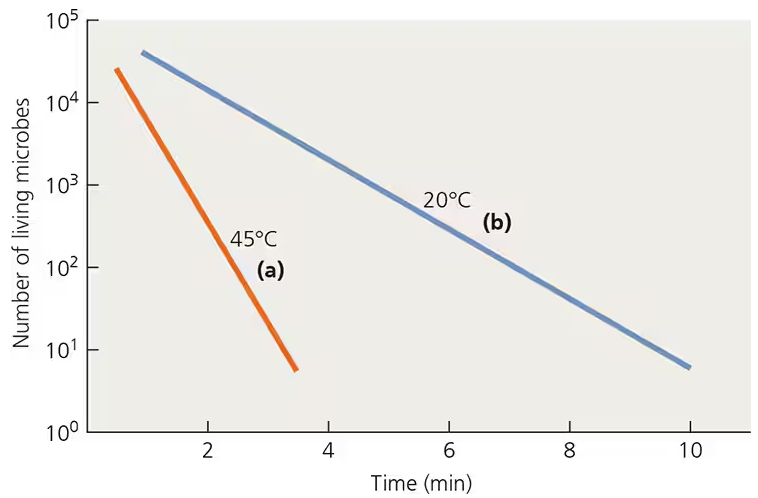
Hyperthermophilic prokaryotes may remain viable in canned goods after commercial sterilization. Why is this situation not dangerous to consumers?
Problem SA12
Why are alcohols more effective in a 70% solution than in a 100% solution?
Problem SA13
Contrast the structures and actions of soaps and quats.
Problem SA14
What are some advantages and disadvantages of using ionizing radiation to sterilize food?
Problem SA15
How can campers effectively treat stream water to remove pathogenic protozoa, bacteria, and viruses?
Problem 9.8a
Which of the following items functions most like an autoclave?
a. boiling pan
b. incinerator
c. microwave oven
d. pressure cooker
Problem 10.1a
Diffusion and dilution tests that expose pathogens to antimicrobials are designed to determine __________ .
a. the spectrum of action of a drug
b. which drug is most effective against a particular pathogen
c. the amount of a drug to use against a particular pathogen
d. both b and c
Problem 10.10a
What is the difference in drug action of synergists contrasted with that of antagonists?
Problem 10.10a
PABA is __________ .
a. a substrate used in the production of penicillin
b. a type of β-lactamase
c. molecularly similar to cephalosporins
d. used to synthesize folic acid
Problem 10.1a
Label each of the accompanying figures to indicate the class of drug that is stopping polypeptide translation.
<IMAGE> <IMAGE>
a. ________________ b. _________________
block initiation. change 30S subunit.
<IMAGE> <IMAGE>
c. ________________ d. _________________
block ribosome attachment inhibits peptide bonding
<IMAGE> <IMAGE>
e. ________________ g. _________________
f. ________________ h. _________________
block ribosome movement block tRNA docking
Problem 10.1a
What characteristics would an ideal chemotherapeutic agent have? Which drug has these qualities?
Problem 10.2a
In a Kirby-Bauer susceptibility test, the presence of a zone of inhibition around disks containing antimicrobial agents indicates __________ .
a. that the microbe does not grow in the presence of the agents
b. that the microbe grows well in the presence of the agents
c. the smallest amount of the agent that will inhibit the growth of the microbe
d. the minimum amount of an agent that kills the microbe in question
Problem 10.2a
What specific test for antimicrobial efficacy is shown? What does this test measure? Draw an oval to predict the size and shape of the zone of inhibition if the drug concentration on the strip were increased twofold.
<IMAGE>
Problem 10.2a
Contrast narrow-spectrum and broad-spectrum drugs. Which are more effective?
Problem 10.3a
The key to successful chemotherapy is __________ .
a. selective toxicity
b. a diffusion test
c. the minimum inhibitory concentration test
d. the spectrum of action
Problem 10.3a
Why is the fact that drug Z destroys the NAM portions of a cell’s wall structure an important factor in considering the drug for chemotherapy?
Problem 10.4a
Which of the following statements is relevant in explaining why sulfonamides are effective?
a. Sulfonamides attach to sterol lipids in the pathogen, disrupt the membranes, and lyse the cells.
b. Sulfonamides prevent the incorporation of amino acids into polypeptide chains.
c. Humans and microbes use PABA differently in their metabolism.
d. Sulfonamides inhibit DNA replication in both pathogens and human cells.
Problem 10.4a
Given that both human cells and pathogens synthesize proteins at ribosomal sites, how can antimicrobial agents that target this process be safe to use in humans?
Problem 10.5a
Cross resistance is __________ .
a. the deactivation of an antimicrobial agent by a bacterial enzyme
b. alteration of the resistant cells so that an antimicrobial agent cannot attach
c. the mutation of genes that affect the cytoplasmic membrane channels so that antimicrobial agents cannot cross into the cell’s interior
d. resistance to one antimicrobial agent because of its similarity to another antimicrobial agent
Problem 10.6a
Multiple-drug-resistant microbes _____________________ .
a. are resistant to all antimicrobial agents
b. respond to new antimicrobials by developing resistance
c. frequently develop in hospitals
d. all of the above
Problem 10.7a
Which of the following is most closely associated with a beta-lactam ring?
a. penicillin
b. vancomycin
c. bacitracin
d. isoniazid
Problem 10.8a
Drugs that act against protein synthesis include ___________ .
a. beta-lactams
b. trimethoprim
c. polymyxin
d. aminoglycosides
Problem 10.8a
A man has been given a broad-spectrum antibiotic for his stomach ulcer. What unintended consequences could arise from this therapy?
Problem 10.9a
Compare and contrast the actions of polyenes, azoles, allylamines, and polymyxin.
Problem 10.9a
Which of the following statements is false concerning antiviral drugs?
a. Macrolide drugs block attachment sites on the host cell wall and prevent viruses from entering.
b. Drugs that neutralize the acidity of phagolysosomes prevent viral uncoating.
c. Nucleotide analogs can be used to stop microbial replication.
d. Drugs containing protease inhibitors retard viral growth by blocking the production of essential viral proteins.
Problem 26.1a
Intrinsic factors affecting food spoilage are properties of _______ rather than _______.
Problem 26.11a
Lyophilization in food preservation is by ________.
a. cell lysis
b. gamma radiation
c. rapid heating
d. freeze-drying
Problem 26.2a
Leaving foods out at room temperature ________the likelihood of food spoilage.
Problem 26.3a
Which of the following lists foods in order, from perishable to nonperishable?
a. dried pasta, cheese, fruit, uncooked ground beef
b. dried pasta, fruit, uncooked ground beef, cheese
c. uncooked ground beef, fruit, cheese, dried pasta
d. uncooked ground beef, fruit, dried pasta, cheese
Problem 26.3a
Indicate whether each of the following statements is true or false. Rewrite the underlined phrase to make a false statement true.
_______Pasteurization kills mesophilic microorganisms except endospore formers.
Ch. 9 - Controlling Microbial Growth in the Environment