Hyperthermophilic prokaryotes may remain viable in canned goods after commercial sterilization. Why is this situation not dangerous to consumers?
Ch. 9 - Controlling Microbial Growth in the Environment
Bauman6th EditionMicrobiology with Diseases by TaxonomyISBN: 9780134832302Not the one you use?Change textbook
Chapter 9, Problem 13
Contrast the structures and actions of soaps and quats.
Verified step by step guidance1
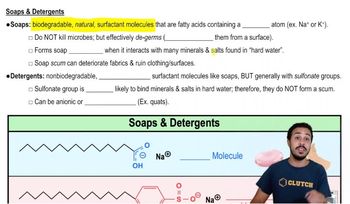
Begin by defining soaps: they are salts of fatty acids that act as surfactants, meaning they reduce surface tension and help emulsify oils and dirt, allowing them to be washed away with water.
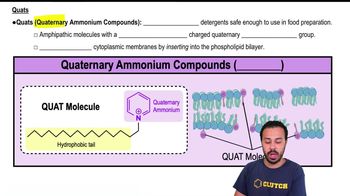
Next, describe quats (quaternary ammonium compounds): these are positively charged disinfectants that disrupt microbial cell membranes, leading to leakage of cell contents and cell death.
Contrast the chemical structures: soaps have a long hydrophobic hydrocarbon tail and a hydrophilic carboxylate head, while quats have a positively charged nitrogen atom bonded to four organic groups, giving them a cationic nature.
Explain their modes of action: soaps primarily clean by emulsifying oils and physically removing microbes, whereas quats chemically disrupt microbial membranes and have antimicrobial properties.
Summarize the differences in usage: soaps are mainly used for cleaning and degerming, while quats are used as disinfectants and antiseptics due to their ability to kill or inhibit microbes.

Verified video answer for a similar problem:
This video solution was recommended by our tutors as helpful for the problem above.
Video duration:
1mWas this helpful?
Key Concepts
Here are the essential concepts you must grasp in order to answer the question correctly.
Structure and Composition of Soaps
Soaps are salts of fatty acids, typically formed by the saponification of fats with an alkali. They have a hydrophobic tail that binds to oils and grease, and a hydrophilic head that interacts with water, enabling the emulsification and removal of dirt.
Recommended video:
Guided course
Soaps & Detergents
Structure and Composition of Quaternary Ammonium Compounds (Quats)
Quats are cationic surfactants containing a positively charged nitrogen atom bonded to four organic groups. Their structure allows them to disrupt microbial cell membranes, making them effective disinfectants with antimicrobial properties.
Recommended video:
Guided course
Quats
Mechanism of Action and Uses of Soaps vs. Quats
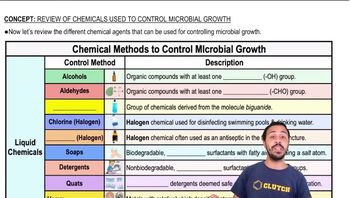
Soaps primarily act as detergents that remove dirt and microbes mechanically by emulsification, but have limited antimicrobial activity. Quats, however, kill microbes by disrupting cell membranes and are widely used as disinfectants in healthcare and sanitation.
Recommended video:
Guided course
Review of Chemicals Used to Control Microbial Growth
Related Practice
Textbook Question
809
views
Textbook Question
What are some advantages and disadvantages of using ionizing radiation to sterilize food?
966
views
Textbook Question
Which of the following adjectives best describes a surgical procedure that is free of microbial contaminants?
a. Disinfected
b. Sanitized
c. Degermed
d. Aseptic
780
views
Textbook Question
Biosafety Level 3 includes:
a. Double sets of entry doors
b. Pressurized suits
c. Showers in entryways
d. All of the above
670
views
Textbook Question
A sample of E. coli has been subjected to heat for a specified time, and 90% of the cells have been destroyed. Which of the following terms best describes this event?
a. Thermal death point
b. Thermal death time
c. Decimal reduction time
d. None of the above
824
views
Textbook Question
Why are alcohols more effective in a 70% solution than in a 100% solution?
1491
views