Back
Back
Problem 1
Differentiate the terms in each of the following pairs:
a. Etiology and pathogenesis
b. Infection and disease
c. Communicable disease and noncommunicable disease
Problem 2
Define symbiosis. Differentiate commensalism, mutualism, and parasitism, and give an example of each.
Problem 3
Indicate whether each of the following conditions is typical of subacute, chronic, or acute infections.
a. The patient experiences a rapid onset of malaise; symptoms last 5 days
b. The patient experiences cough and breathing difficulty for months
c. The patient has no apparent symptoms and is a known carrier
Problem 4
Among hospital patients who have infections, one-third did not enter the hospital with the infection but rather acquired it in the hospital. How do they acquire these infections? What is the method of transmission of these infections? What is the reservoir of infection?
Problem 5
Distinguish symptoms from signs as signals of disease.
Problem 6
How can a local infection become a systemic infection?
Problem 7
Why are some organisms that constitute the normal microbiota described as commensals, whereas others are described as mutualistic?
Problem 8
Put the following in the correct order to describe the pattern of disease: period of convalescence, prodromal period, period of decline, incubation period, period of illness.
Problem 9
This microbe is acquired by humans as infants and is essential for good health. Acquiring a closely related strain causes severe stomach cramps, bloody diarrhea, and vomiting. What is the microbe?
Problem 10
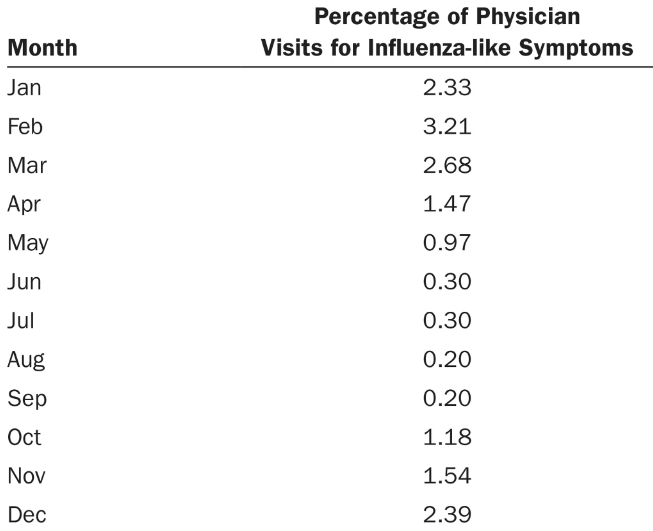
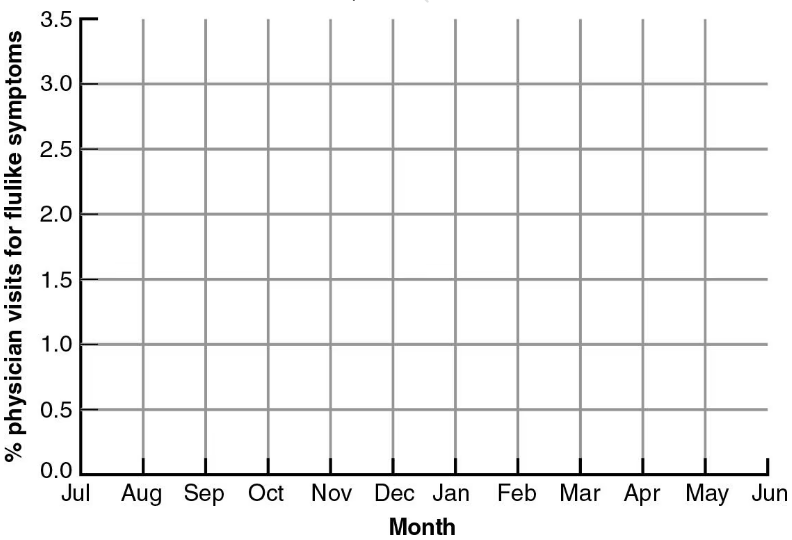
Using the following data, draw a graph showing the incidence of influenza during a typical year. Indicate the endemic and epidemic levels.
Problem 1
The emergence of new infectious diseases is probably due to all of the following except:
a. The need of bacteria to cause disease
b. The ability of humans to travel by air
c. Changing environments (e.g., flood, drought, pollution)
d. A pathogen crossing the species barrier
e. The increasing human population
Problem 2
All members of a group of ornithologists studying barn owls in the wild have had
salmonellosis (Salmonella gastroenteritis). One birder is experiencing her third infection. What is the most likely source of their infections?
a. The ornithologists are eating the same food.
b. They are contaminating their hands while handling the owls and nests.
c. One of the workers is a Salmonella carrier.
d. Their drinking water is contaminated.
Problem 3
Which of the following statements is false?
a. E. coli never causes disease
b. E. coli provides vitamin K for its host
c. E. coli often exists in a mutualistic relationship with humans
d. A disease-causing strain of E. coli causes bloody diarrhea
Problem 4
Which of the following is not one of Koch's postulates?
a. The same pathogen must be present in every case of the disease.
b. The pathogen must be isolated and grown in pure culture from the diseased host.
c. The pathogen from pure culture must cause the disease when inoculated into a healthy, susceptible laboratory animal.
d. The disease must be transmitted from a diseased animal to a healthy, susceptible animal by direct contact.
e. The pathogen must be isolated in pure culture from an experimentally infected lab animal.
Problem 5
Which one of the following diseases is not correctly matched to its reservoir?
a. Influenza-animal
b. Rabies-animal
c. Botulism-nonliving
d. Anthrax-nonliving
e. Toxoplasmosis-cats
Problem 6
Use the following information to answer questions 6–7.
On September 6, a 6-year-old boy experienced fever, chills, and vomiting. On September 7, the child was hospitalized with diarrhea and swollen lymph nodes under both arms. On September 3, he had been scratched and bitten by a cat. The cat was found dead on September 5, and Y. pestis was isolated from the cat. Chloramphenicol was administered to the child from September 7, when Y. pestis was isolated from his blood. On September 17, the child's temperature returned to normal. On September 22, the child was released from the hospital.
Identify the incubation period for this case of bubonic plague.
a. September 3-5
b. September 3-6
c. September 6-7
d. September 6-17
Problem 7
Use the following information to answer questions 6–7.
On September 6, a 6-year-old boy experienced fever, chills, and vomiting. On September 7, the child was hospitalized with diarrhea and swollen lymph nodes under both arms. On September 3, he had been scratched and bitten by a cat. The cat was found dead on September 5, and Y. pestis was isolated from the cat. Chloramphenicol was administered to the child from September 7, when Y. pestis was isolated from his blood. On September 17, the child's temperature returned to normal. On September 22, the child was released from the hospital
Identify the prodromal period for this disease.
a. September 3-5
b. September 3-6
c. September 6-7
d. September 6-17
Problem 8
Use the following information to answer questions 8–10.
A Maryland woman was hospitalized with dehydration. V. cholerae and Plesiomonas shigelloides were isolated from the patient, who had neither traveled outside the United States nor eaten raw shellfish during the preceding month. The patient had attended a party before hospitalization. Two other people at the party had acute diarrheal illness and elevated levels of serum antibodies against Vibrio. Everyone at the party ate crabs and rice pudding with coconut milk. Crabs left over from this party were served at a second party. One of the people at the second party had onset of mild diarrhea; specimens from of these people were negative for vibriocidal antibodies.
This is an example of
a. vehicle transmission.
b. airborne transmission.
c. transmission by fomites.
d. direct contact transmission.
e. healthcare-associated transmission.
Problem 10
Use the following information to answer questions 8–10.
A Maryland woman was hospitalized with dehydration. V. cholerae and Plesiomonas shigelloides were isolated from the patient, who had neither traveled outside the United States nor eaten raw shellfish during the preceding month. The patient had attended a party before hospitalization. Two other people at the party had acute diarrheal illness and elevated levels of serum antibodies against Vibrio. Everyone at the party ate crabs and rice pudding with coconut milk. Crabs left over from this party were served at a second party. One of the people at the second party had onset of mild diarrhea; specimens from of these people were negative for vibriocidal antibodies.
The source of the disease was
a. Plesiomonas shigelloides.
b. crabs.
c. V. cholerae.
d. coconut milk.
e. rice.