Back
Back Tortora 14th EditionCh. 26 - Microbial Diseases of the Urinary and Reproductive Systems
Problem 1
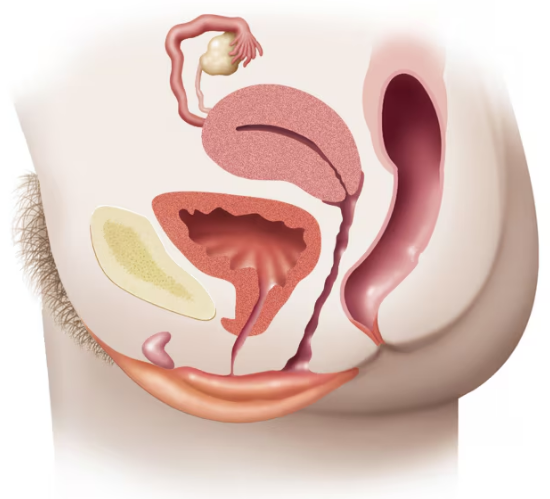
Diagram the pathway taken by E. coli to cause cystitis. Do the same for pyelonephritis. Diagram the pathway taken by N. gonorrhoeae to cause PID.
Problem 2
How are urinary tract infections acquired?
Problem 3
Explain why E. coli is frequently implicated in cystitis in females.
Problem 4
Name one organism that causes pyelonephritis. What are the portals of entry for microbes that cause pyelonephritis?
Problem 5
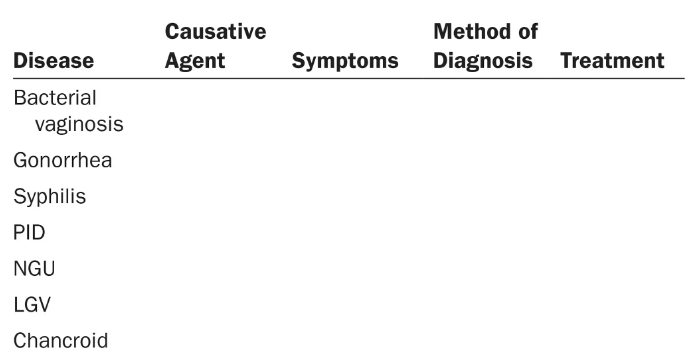
Complete the following table
Problem 6
Describe the symptoms of genital herpes. What is the causative agent? When is this infection least likely to be transmitted?
Problem 7
Name one fungus and one protozoan that can cause genital system infections. What symptoms would lead you to suspect these infections?
Problem 8
List the genital infections that cause congenital and neonatal infections. How can transmission to a fetus or newborn be prevented?
Problem 9
Intracellular reticulate bodies of this gram-negative bacterium convert to elementary bodies that can infect a new host cell.
Problem 1
Which of the following is usually transmitted by contaminated water?
a. Chlamydia
b. Leptospirosis
c. Syphilis
d. Trichomoniasis
e. None of the above
Problem 2
Use the following choices to answer questions 2–5:
a. Candida
b. Chlamydia
c. Gardnerella
d. Neisseria
e. Trichomonas
Microscopic examination of vaginal smear shows flagellated eukaryotes.
Problem 3
Use the following choices to answer questions 2–5:
a. Candida
b. Chlamydia
c. Gardnerella
d. Neisseria
e. Trichomonas
Microscopic examination of vaginal smear shows ovoid eukaryotic cell.
Problem 4
Use the following choices to answer questions 2–5:
a. Candida
b. Chlamydia
c. Gardnerella
d. Neisseria
e. Trichomonas
Microscopic examination of vaginal smear shows epithelial cells covered with bacteria.
Problem 5
Use the following choices to answer questions 2–5:
a. Candida
b. Chlamydia
c. Gardnerella
d. Neisseria
e. Trichomonas
Microscopic examination of vaginal smear shows gram-negative cocci in phagocytes.
Problem 6
Use the following choices to answer the following question:
a. Candidiasis
b. Bacterial vaginosis
c. Genital herpes
d. Lymphogranuloma venereum
e. Trichomoniasis
Difficult to treat with chemotherapy.
Problem 7
Fluid-filled vesicles
a. candidiasis
b. bacterial vaginosis
c. genital herpes
d. lymphogranuloma venereum
e. trichomoniasis
Problem 8
Frothy, fishy discharge
a. candidiasis
b. bacterial vaginosis
c. genital herpes
d. lymphogranuloma venereum
e. trichomoniasis
Problem 9
The most common cause of cystitis
a. C. trachomatis
b. E. coli
c. Mycobacterium hominis
d. S. saprophyticus
Problem 10
In cases of NGU, diagnosis is made using PCR to detect microbial DNA.
a. C. trachomatis
b. E. coli
c. Mycobacterium hominis
d. S. saprophyticus