What is the Acceptable Macronutrient Distribution Range (AMDR) for total fat intake according to the Dietary Reference Intakes?
The AMDR for total fat intake is 20–35% of total daily calories.
According to the Dietary Reference Intakes, what percentage of daily calories should come from fat?
According to the DRIs, 20–35% of daily calories should come from fat.
What is the recommended range for fat intake as a percentage of total daily calories based on the Acceptable Macronutrient Distribution Range (AMDR)?
The recommended range for fat intake is 20–35% of total daily calories.
What does an intake of 2.4 micrograms (mcg) of vitamin B12 represent in the context of Dietary Reference Intakes?
An intake of 2.4 mcg of vitamin B12 typically represents the Recommended Dietary Allowance (RDA) for healthy adults, which is the amount estimated to meet the needs of 97–98% of individuals in that group.
Who establishes the Dietary Reference Intakes (DRIs) in the United States?
The DRIs are established by the National Academy of Sciences, an independent organization not part of the federal government. They provide specific recommendations for nutrient and caloric intake.
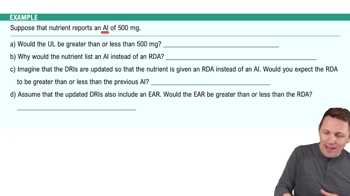
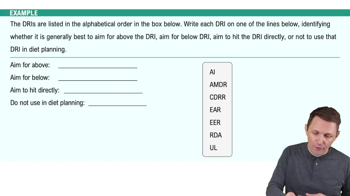
What is the main purpose of the Tolerable Upper Intake Level (UL) in the DRIs?
The UL is the highest daily intake of a nutrient that does not pose a risk of adverse health effects. Consuming more than the UL increases the risk of toxicity.
How does the Adequate Intake (AI) differ from the Recommended Dietary Allowance (RDA)?
AI is set when there is not enough scientific evidence to establish an RDA. It is an estimated amount assumed to be sufficient for health.
What is the Estimated Average Requirement (EAR) used for in nutrition science?
The EAR is the amount of a nutrient estimated to meet the needs of 50% of individuals in a group. It is mainly used for research and policy, not for individual recommendations.
What factors are considered when calculating the Estimated Energy Requirement (EER)?
The EER calculation takes into account age, sex, height, weight, and physical activity level. It provides an estimated typical number of calories needed for an individual.
What is the Chronic Disease Risk Reduction Intake (CDRR) and for which nutrient is it currently set?
The CDRR is a DRI value indicating the intake level of a nutrient that reduces the risk of chronic disease. Currently, it is only set for sodium to help reduce the risk of hypertension.
 Back
Back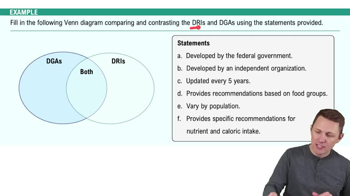
 02:29
02:29