What reagents are required to carry out the following synthesis?
Ch. 18 - Reactions of Benzene and Substituted Benzenes
Chapter 19, Problem 85a
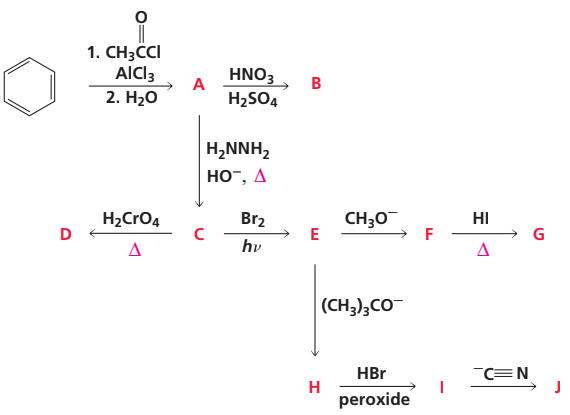
Identify A–J:

Verified step by step guidance1
Step 1: Analyze the first reaction. The starting material is benzene, and it reacts with CH3CH2CCl/AlCl3. This is a Friedel-Crafts acylation reaction, where the acyl group (CH3CH2CO-) is introduced onto the benzene ring. The product A will be an aromatic ketone.
Step 2: Examine the second reaction. Compound A reacts with hydrazine (H2NNH2) in the presence of a base (HO-) and heat (Δ). This is the Wolff-Kishner reduction, which converts the carbonyl group (C=O) in ketones to a methylene group (-CH2). The product B will be an alkylbenzene.
Step 3: Note the presence of ethylene glycol (HOCH2CH2OH) in the second step. Ethylene glycol is often used as a solvent or stabilizing agent in high-temperature reactions, but it does not directly participate in the Wolff-Kishner reduction.
Step 4: Summarize the transformations. Compound A is formed by the acylation of benzene, resulting in an aromatic ketone. Compound B is formed by the reduction of the ketone group in A to a methylene group, yielding an alkylbenzene.
Step 5: To identify A and B, consider the specific acyl group introduced in the first step (CH3CH2CO-) and the subsequent reduction of the ketone group. A is ethyl phenyl ketone (C6H5COCH2CH3), and B is ethylbenzene (C6H5CH2CH3).

Verified video answer for a similar problem:
This video solution was recommended by our tutors as helpful for the problem above.
Video duration:
5mWas this helpful?
Key Concepts
Here are the essential concepts you must grasp in order to answer the question correctly.
Friedel-Crafts Acylation
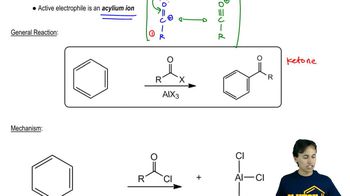
Friedel-Crafts acylation is a key reaction in organic chemistry that introduces an acyl group into an aromatic ring. This reaction typically involves the use of an acyl chloride and a Lewis acid catalyst, such as AlCl3, to form an acylaromatic compound. The product, compound A in the diagram, retains the aromaticity of the benzene ring while adding a carbonyl functional group.
Recommended video:
Guided course
Friedel-Crafts Acylation
Wolff-Kishner Reduction
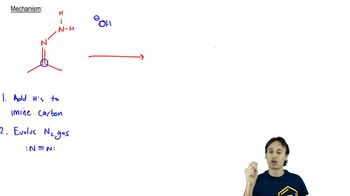
The Wolff-Kishner reduction is a method used to convert carbonyl compounds into alkanes by removing the oxygen functionality. This reaction employs hydrazine (H2NNH2) and a strong base, often under heat, to facilitate the reduction. In the provided diagram, the transformation from compound A to compound B illustrates this reduction process, resulting in the formation of an alkane.
Recommended video:
Guided course
Mechanism
Hydrazine and Base Reaction
Hydrazine (H2NNH2) acts as a reducing agent in organic reactions, particularly in the Wolff-Kishner reduction. When combined with a strong base, it promotes the conversion of carbonyl groups to hydrocarbons. The reaction typically requires heating to drive the elimination of nitrogen gas, leading to the formation of the final product, which is a diol in this case, as shown in the transformation from compound B.
Recommended video:
Guided course
Recognizing Acid-Base Reactions.
Related Practice
Textbook Question
1297
views
Textbook Question
Identify A–J:
1264
views
Textbook Question
Identify A–J:
1242
views
Textbook Question
The pKa values of a few ortho-, meta-, and para-substituted benzoic acids are shown below:
The relative pKa values depend on the substituent. For chloro-substituted benzoic acids, the ortho isomer is the most acidic and the para isomer is the least acidic; for nitro-substituted benzoic acids, the ortho isomer is the most acidic and the meta isomer is the least acidic; and for amino-substituted benzoic acids, the meta isomer is the most acidic and the ortho isomer is the least acidic.
Explain these relative acidities.
a. Cl: ortho > meta > para
4577
views
Textbook Question
What reagents are required to carry out the following synthesis?
1069
views
Textbook Question
Describe two synthetic routes for the preparation of p-methoxyaniline from benzene.
794
views