Ch. 2 - General Chemistry Translated: Finding the Electrons
Mullins - Organic Chemistry: A Learner Centered Approach 1st Edition
Mullins1st EditionOrganic Chemistry: A Learner Centered ApproachISBN: 9780137566471Not the one you use?Change textbook
Chapter 1, Problem 67c

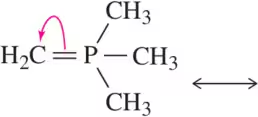
Identify the resonance structure that will be produced given the molecule shown and the electron flow indicated.
(c) Molecule with a phosphorus atom, showing resonance structure and electron flow indicated by a pink arrow.

Verified step by step guidance
1
Examine the molecule provided and identify the location of the electron flow indicated by arrows. Resonance structures are formed by the movement of electrons, typically involving π bonds, lone pairs, or charges.
Determine the type of electron movement shown. For example, if the arrow starts from a lone pair or π bond and points toward an adjacent atom or bond, this indicates the formation of a new bond or the relocation of electrons.
Apply the rules of resonance: ensure that the movement of electrons does not violate the octet rule for second-row elements (C, N, O, etc.) and that the overall charge of the molecule remains conserved.
Redraw the molecule to reflect the new electron arrangement. Update the positions of π bonds, lone pairs, and charges based on the indicated electron flow.
Verify the stability of the resonance structure by checking for minimized formal charges and ensuring that electronegative atoms (like oxygen or nitrogen) preferentially hold negative charges, if applicable.

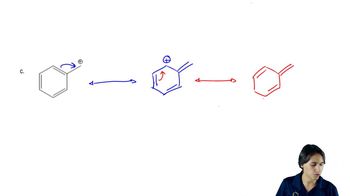
Verified video answer for a similar problem:

This video solution was recommended by our tutors as helpful for the problem above.
Video duration:
2m
Was this helpful?

Key Concepts

Here are the essential concepts you must grasp in order to answer the question correctly.

Resonance Structures

Resonance structures are different ways of drawing the same molecule that illustrate the delocalization of electrons. They are used to represent molecules where the electron distribution cannot be depicted by a single Lewis structure. Each resonance structure contributes to the overall hybrid structure, which is more stable than any individual form.
Recommended video:
Guided course
03:04
Drawing Resonance Structures

Electron Flow

Electron flow refers to the movement of electrons during chemical reactions or within molecules, often depicted using arrows in reaction mechanisms. Understanding electron flow is crucial for predicting how molecules will react and how resonance structures are formed, as it shows how electrons are redistributed among atoms.
Recommended video:
Guided course
03:54
The 18 and 16 Electron Rule

Stability of Resonance Structures

The stability of resonance structures is determined by factors such as the octet rule, charge distribution, and the presence of formal charges. More stable resonance structures contribute more to the resonance hybrid, while less stable forms are less significant. Recognizing which structures are more stable helps in predicting the behavior of the molecule in chemical reactions.
Recommended video:
Guided course
03:04
Drawing Resonance Structures