Ch. 3 - An Introduction to Organic Compounds:Nomenclature, Physical Properties, and Structure
Bruice - Organic Chemistry 8th Edition
Bruice8th EditionOrganic ChemistryISBN: 9780135213711Not the one you use?Change textbook
Chapter 4, Problem 12f

Which isomers contain a tert-butyl group?

Verified step by step guidance
1
Step 1: Understand the structure of a tert-butyl group. A tert-butyl group is a branched alkyl group with the formula (CH₃)₃C-. It consists of a central carbon atom bonded to three methyl groups and one other group.
Step 2: Analyze each isomer in the image to identify the presence of a tert-butyl group. Look for a central carbon atom bonded to three methyl groups.
Step 3: Examine Isomer 6. It contains a central carbon atom bonded to three methyl groups, which is characteristic of a tert-butyl group.
Step 4: Examine Isomer 11. It also contains a central carbon atom bonded to three methyl groups, indicating the presence of a tert-butyl group.
Step 5: Conclude that Isomers 6 and 11 contain a tert-butyl group based on their structural features.

Verified video answer for a similar problem:

This video solution was recommended by our tutors as helpful for the problem above.
Video duration:
57s
Was this helpful?

Key Concepts

Here are the essential concepts you must grasp in order to answer the question correctly.

Tert-butyl group

The tert-butyl group is a branched alkyl group derived from butane, characterized by the structure -C(CH3)3. It consists of a central carbon atom bonded to three methyl groups and one other carbon chain. This group is commonly encountered in organic chemistry and is significant in determining the properties and reactivity of molecules.
Recommended video:
Guided course
05:49
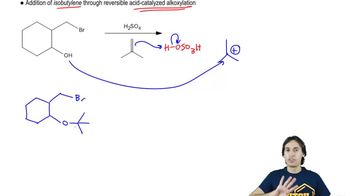
Mechanism of t-Butyl Ether Protecting Groups.

Isomerism

Isomerism refers to the phenomenon where two or more compounds have the same molecular formula but different structural arrangements or spatial orientations. In organic chemistry, isomers can be classified into structural isomers, which differ in the connectivity of atoms, and stereoisomers, which differ in the spatial arrangement of atoms. Understanding isomerism is crucial for identifying and categorizing organic compounds.
Recommended video:
Guided course
06:47
Monosaccharides - D and L Isomerism

Structural representation

Structural representation in organic chemistry visually depicts the arrangement of atoms within a molecule. It includes line-angle formulas, which simplify the representation of carbon chains and functional groups. Analyzing structural representations helps chemists identify functional groups, isomers, and the overall molecular architecture, which is essential for understanding chemical behavior and reactivity.
Recommended video:
Guided course
05:09
Representations of L-Configuration