Ch. 4 - Acids and Bases: Electron Flow
Mullins - Organic Chemistry: A Learner Centered Approach 1st Edition
Mullins1st EditionOrganic Chemistry: A Learner Centered ApproachISBN: 9780137566471Not the one you use?Change textbook
Chapter 3, Problem 4.24

An unknown base (B⁻) has been identified as very weak. What does this tell you about the strength of its conjugate acid, HB? Is it stable or unstable? Is it reactive or unreactive?

Verified step by step guidance
1
Identify the relationship between the strength of a base and its conjugate acid. A very weak base typically has a strong conjugate acid.
Recall that the strength of an acid is related to its ability to donate a proton (H⁺). A strong acid readily donates a proton, indicating that its conjugate base is stable.
Consider the stability of the conjugate acid, HB. Since B⁻ is a very weak base, HB is a strong acid, which means it is stable after donating a proton.
Evaluate the reactivity of the conjugate acid, HB. A strong acid is generally more reactive in terms of donating protons compared to a weak acid.
Conclude that the conjugate acid, HB, is strong, stable, and reactive in terms of proton donation.

Key Concepts

Here are the essential concepts you must grasp in order to answer the question correctly.

Conjugate Acid-Base Relationship

In acid-base chemistry, a conjugate acid is formed when a base accepts a proton (H⁺). The strength of a base is inversely related to the strength of its conjugate acid; thus, if a base is very weak, its conjugate acid is likely to be strong. This relationship is fundamental in predicting the behavior of acids and bases in chemical reactions.
Recommended video:
Guided course
02:11
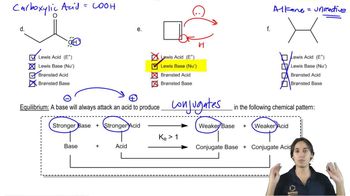
Equilibrium constant and conjugates.

Stability of Conjugate Acids

The stability of a conjugate acid is influenced by its ability to stabilize the positive charge that results from protonation. A weak base typically corresponds to a stable conjugate acid, as the conjugate acid can effectively distribute the positive charge. This stability often leads to lower reactivity, as stable species are less likely to participate in further reactions.
Recommended video:
Guided course
04:31
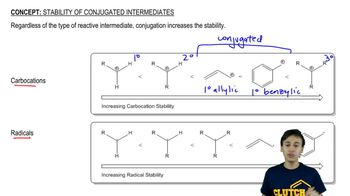
Stability of Conjugated Intermediates

Reactivity of Acids and Bases

Reactivity in organic chemistry often correlates with the stability of the species involved. A stable conjugate acid, resulting from a weak base, tends to be less reactive because it does not readily donate protons. Conversely, strong acids, which have weak conjugate bases, are more reactive due to their tendency to lose protons easily, making the understanding of reactivity crucial in predicting chemical behavior.
Recommended video:
Guided course
02:49
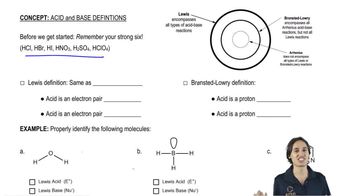
The Lewis definition of acids and bases.