Ch. 2 - Acids and Bases: Central to Understanding Organic Chemistry
Bruice - Organic Chemistry 8th Edition
Bruice8th EditionOrganic ChemistryISBN: 9780135213711Not the one you use?Change textbook
Chapter 3, Problem 32a,b

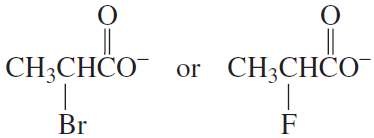
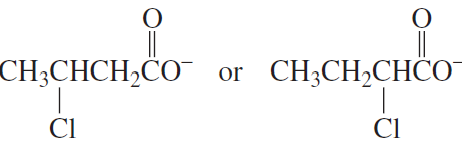
Which is a stronger base?
a. Chemical structures comparing the acidity of two compounds, one with a bromine atom and the other with a fluorine atom.
b. Chemical structures comparing two compounds with chloride and carboxylate groups, questioning which is a stronger base.

Verified step by step guidance
1
Step 1: Analyze the chemical structures in part A. Both molecules are carboxylate anions, but one has an iodine substituent (i) and the other has a chlorine substituent (ii). Consider the electronegativity of the substituents. Chlorine is more electronegative than iodine, which means it will withdraw electron density more effectively through inductive effects.
Step 2: Understand how electronegativity affects basicity. A more electronegative substituent stabilizes the negative charge on the carboxylate group, making the molecule less likely to act as a base. Therefore, the molecule with the chlorine substituent (ii) is expected to be a weaker base compared to the molecule with the iodine substituent (i).
Step 3: Analyze the chemical structures in part B. Both molecules are carboxylate anions, but one has a single hydroxyl group (i) and the other has two hydroxyl groups (ii). Hydroxyl groups can participate in hydrogen bonding and also withdraw electron density through inductive effects.
Step 4: Compare the electron-withdrawing effects of the hydroxyl groups in part B. The molecule with two hydroxyl groups (ii) will have a stronger electron-withdrawing effect compared to the molecule with one hydroxyl group (i). This stabilizes the negative charge on the carboxylate group, making molecule (ii) a weaker base.
Step 5: Summarize the findings. In part A, the molecule with iodine (i) is the stronger base. In part B, the molecule with one hydroxyl group (i) is the stronger base. The reasoning is based on the inductive effects of the substituents and their ability to stabilize the negative charge on the carboxylate group.

Verified video answer for a similar problem:

This video solution was recommended by our tutors as helpful for the problem above.
Video duration:
4m
Was this helpful?

Key Concepts

Here are the essential concepts you must grasp in order to answer the question correctly.

Acidity and Basicity

In organic chemistry, the strength of a base is often determined by its ability to accept protons (H+). A stronger base has a higher tendency to accept protons, which is influenced by the stability of the conjugate acid formed after protonation. Understanding the relationship between acidity and basicity is crucial for comparing the strength of different bases.
Recommended video:
Guided course
06:21
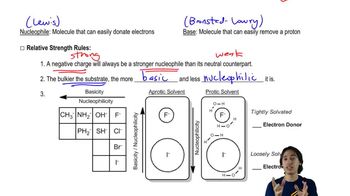
Understanding the difference between basicity and nucleophilicity.

Resonance Stabilization

Resonance stabilization occurs when a molecule can be represented by multiple valid Lewis structures, allowing for the delocalization of electrons. In the context of basicity, a base that can stabilize its conjugate acid through resonance will generally be a weaker base, as the negative charge is more stabilized and less likely to accept a proton.
Recommended video:
Guided course
03:43
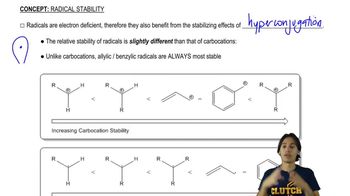
The radical stability trend.

Inductive Effect

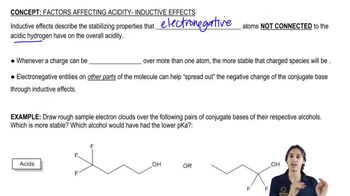
The inductive effect refers to the electron-withdrawing or electron-donating effects of substituents attached to a molecule. Electron-withdrawing groups (like Cl) can decrease the basicity of a compound by stabilizing the negative charge on the conjugate base, while electron-donating groups can enhance basicity. Analyzing the substituents in the given structures is essential for determining which base is stronger.
Recommended video:
Guided course
01:47
Understanding the Inductive Effect.