Ch. 14 - Structural Identification I: Infrared Spectroscopy and Mass Spectrometry
Mullins - Organic Chemistry: A Learner Centered Approach 1st Edition
Mullins1st EditionOrganic Chemistry: A Learner Centered ApproachISBN: 9780137566471Not the one you use?Change textbook
Chapter 13, Problem 45

Assign the structure based on the mass spectrum and IR spectrum shown.
<IMAGE>

Verified step by step guidance
1
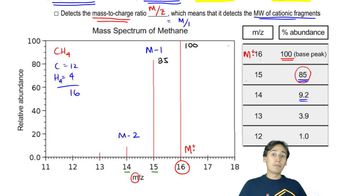
Examine the mass spectrum to identify the molecular ion peak, which is the peak with the highest m/z value. This peak represents the molecular weight of the compound.
Look for significant peaks in the mass spectrum that could indicate common fragmentations. For example, a peak at m/z 15 could suggest a methyl group, while a peak at m/z 29 could indicate an ethyl group.
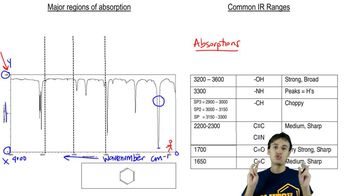
Analyze the IR spectrum for characteristic absorption bands. A broad peak around 3300 cm-1 could indicate an O-H or N-H bond, while a sharp peak around 1700 cm-1 could suggest a C=O bond.
Combine the information from both spectra. Use the molecular ion peak to determine the possible molecular formula and the IR spectrum to identify functional groups present in the molecule.
Propose a structure that fits both the mass spectrum and IR spectrum data. Ensure that the proposed structure accounts for all significant peaks and functional groups identified in the spectra.

Verified video answer for a similar problem:

This video solution was recommended by our tutors as helpful for the problem above.
Video duration:
6m
Was this helpful?

Key Concepts

Here are the essential concepts you must grasp in order to answer the question correctly.

Mass Spectrometry

Mass spectrometry is an analytical technique used to measure the mass-to-charge ratio (m/z) of ions. It helps identify the molecular weight and structure of a compound by analyzing the fragmentation pattern. Peaks in the mass spectrum represent different fragments, with the highest m/z peak often corresponding to the molecular ion, indicating the molecular weight of the compound.
Recommended video:
Guided course
01:25
How to Read a Mass Spectrum

Infrared (IR) Spectroscopy

IR spectroscopy is a technique used to identify functional groups in a molecule by measuring the absorption of infrared light at different wavenumbers. Each functional group absorbs IR radiation at characteristic frequencies, producing a spectrum with peaks that correspond to specific bond vibrations. The presence of peaks at certain wavenumbers can help deduce the functional groups present in the compound.
Recommended video:
Guided course
16:04
General Features of IR Spect

Functional Group Identification

Identifying functional groups is crucial for determining the structure of an organic compound. By analyzing the IR spectrum, one can identify specific functional groups based on characteristic absorption peaks. For example, a broad peak around 3300 cm⁻¹ suggests an O-H bond, while a sharp peak near 1700 cm⁻¹ indicates a C=O bond, aiding in piecing together the compound's structure.
Recommended video:
Guided course
02:36
Identifying Functional Groups