Skip to main content
Organic Chemistry
My Course
Learn
Exam Prep
AI Tutor
Study Guides
Textbook Solutions
Flashcards
Explore
Try the app
My Course
Learn
Exam Prep
AI Tutor
Study Guides
Textbook Solutions
Flashcards
Explore
Try the app
Back
Acid Base Equilibrium definitions
You can tap to flip the card.
Lewis Acid
You can tap to flip the card.
👆
Lewis Acid
Species that accepts an electron pair, often indicated by a positive charge or specific functional groups like carboxylic acids.
Track progress
Control buttons has been changed to "navigation" mode.
1/14
Related flashcards
Related practice
Recommended videos
Acid Base Equilibrium quiz
Acid Base Equilibrium
9 Terms
Acid Base Equilibrium
3. Acids and Bases
7 problems
Topic
Johnny
Ranking Acidity
3. Acids and Bases
7 problems
Topic
Johnny
3. Acids and Bases - Part 1 of 2
4 topics
10 problems
Chapter
Laura
3. Acids and Bases - Part 2 of 2
3 topics
9 problems
Chapter
Johnny
05:11
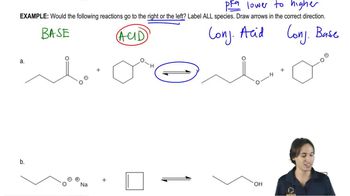
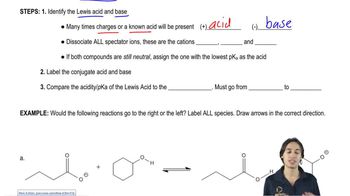
The 3 steps for determining the direction of acid and base equilibrium.
3930
views
29
rank
5
comments
04:00
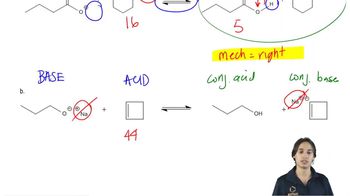
Determining Acid/Base Equilibrium
3609
views
31
rank
11
comments
02:34
Determining Acid/Base Equilibrium
3263
views
38
rank
11
comments
Terms in this set (14)
Hide definitions
Lewis Acid
Species that accepts an electron pair, often indicated by a positive charge or specific functional groups like carboxylic acids.
Lewis Base
Species that donates an electron pair, typically recognized by a negative charge or lone pairs after dissociation.
pKa
Numerical value expressing acid strength; lower values indicate stronger acids, guiding equilibrium direction.
Spectator Ion
Ion, often from Group 1 metals, that does not participate in the acid-base reaction and is ignored in equilibrium analysis.
Conjugate Acid
Species formed when a base gains a proton, serving as the acid in the reverse reaction.
Conjugate Base
Species formed when an acid loses a proton, acting as the base in the reverse reaction.
Carboxylic Acid
Functional group containing a carbonyl and hydroxyl, commonly recognized as an acid in equilibrium problems.
Equilibrium Direction
Preferred side of a reaction, determined by comparing pKa values; favors formation of weaker acids and bases.
Acidity
Measure of a species' tendency to donate a proton, directly related to its pKa value.
Ionic Bond
Electrostatic attraction between oppositely charged ions, often seen with spectator ions in solution.
Cation
Positively charged ion, such as sodium or potassium, frequently acting as a spectator in acid-base reactions.
Functional Group
Specific group of atoms within molecules, like carboxylic acid, that determines chemical reactivity in acid-base contexts.
Neutral Compound
Molecule with no net charge, requiring pKa comparison to assign acid or base roles in equilibrium.
Row 1 Metal
Element from the first column of the periodic table, such as lithium or sodium, often forming spectator ions.
 BackBack

 05:11
05:11