Skip to main content
Organic Chemistry
My Course
Learn
Exam Prep
AI Tutor
Study Guides
Textbook Solutions
Flashcards
Explore
Try the app
My Course
Learn
Exam Prep
AI Tutor
Study Guides
Textbook Solutions
Flashcards
Explore
Try the app
Back
Dehydration Reaction definitions
You can tap to flip the card.
Dehydration Reaction
You can tap to flip the card.
👆
Dehydration Reaction
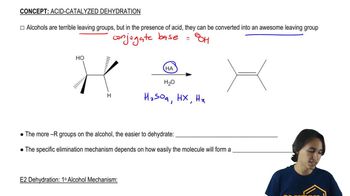
Conversion of an alcohol to an alkene by removing water, typically using an acid catalyst.
Track progress
Control buttons has been changed to "navigation" mode.
1/15
Related flashcards
Related practice
Recommended videos
Dehydration Reaction quiz
Acid-Catalyzed Dehydration
13 Terms
Dehydration Reaction quiz #1
Acid-Catalyzed Dehydration
10 Terms
Dehydration Reaction
9. Alkenes and Alkynes
7 problems
Topic
Ernest
POCl3 Dehydration
9. Alkenes and Alkynes
1 problem
Topic
Ernest
9. Alkenes and Alkynes - Part 1 of 2
5 topics
11 problems
Chapter
Ernest
9. Alkenes and Alkynes - Part 2 of 2
5 topics
11 problems
Chapter
Johnny
05:20
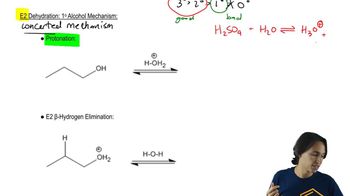
Dehydration of 1° alcohols:The E2 Mechanism
4289
views
30
rank
17
comments
01:06
An extra note of caution with 1° alcohols.
3178
views
19
rank
7
comments
06:01
General features of acid-catalyzed dehydration.
5010
views
36
rank
6
comments
Terms in this set (15)
Hide definitions
Dehydration Reaction
Conversion of an alcohol to an alkene by removing water, typically using an acid catalyst.
Acid Catalyst
Substance like H2SO4 or H3O+ that facilitates reaction steps without being consumed.
Leaving Group
Atom or group that departs with a pair of electrons, often improved by protonation in alcohols.
Protonation
Addition of a proton to a molecule, often making alcohols better leaving groups by forming water.
Carbocation
Positively charged carbon intermediate, whose stability influences reaction mechanism and rearrangement.
E1 Mechanism
Two-step elimination involving carbocation formation, typical for secondary and tertiary alcohols.
E2 Mechanism
Concerted elimination where bond breaking and formation occur simultaneously, common for primary alcohols.
Beta Elimination
Removal of atoms from adjacent carbons, resulting in double bond formation.
Pi Bond
Bond formed by sideways overlap of p orbitals, present in alkenes after elimination.
Hydration Reaction
Addition of water across a double bond, the reverse process of dehydration.
Catalyst Regeneration
Recovery of the catalyst at the end of the reaction, confirming its unchanged status.
Carbocation Rearrangement
Shift of a carbocation to a more stable position, possibly altering the reaction pathway.
Primary Alcohol
Alcohol with the hydroxyl group attached to a carbon bonded to only one other carbon.
Secondary Alcohol
Alcohol with the hydroxyl group attached to a carbon bonded to two other carbons.
Tertiary Alcohol
Alcohol with the hydroxyl group attached to a carbon bonded to three other carbons.
 BackBack

 05:20
05:20