Skip to main content
Organic Chemistry
My Course
Learn
Exam Prep
AI Tutor
Study Guides
Textbook Solutions
Flashcards
Explore
Try the app
My Course
Learn
Exam Prep
AI Tutor
Study Guides
Textbook Solutions
Flashcards
Explore
Try the app
Back
Free Radical Halogenation definitions
You can tap to flip the card.
Alkane
You can tap to flip the card.
👆
Alkane
A saturated hydrocarbon backbone, highly stable and unreactive, commonly sourced from petroleum.
Track progress
Control buttons has been changed to "navigation" mode.
1/15
Related flashcards
Related practice
Recommended videos
Free Radical Halogenation quiz
Radical Chain Reaction
15 Terms
Free Radical Halogenation
11. Radical Reactions
7 problems
Topic
Ernest
Radical Selectivity
11. Radical Reactions
5 problems
Topic
Johnny
11. Radical Reactions - Part 1 of 2
4 topics
11 problems
Chapter
Johnny
11. Radical Reactions - Part 2 of 2
5 topics
13 problems
Chapter
Johnny
02:05
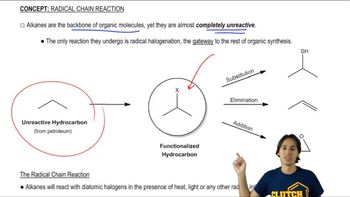
The one reaction that alkanes will actually undergo.
4205
views
51
rank
2
comments
00:34
Explaining the following problem.
3696
views
17
rank
2
comments
04:08
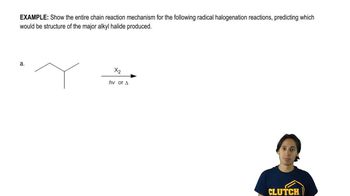
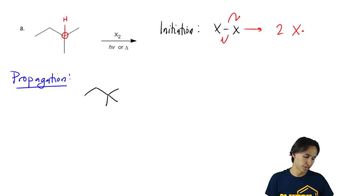
Show the entire chain reaction mechanism.
3443
views
42
rank
21
comments
Terms in this set (15)
Hide definitions
Alkane
A saturated hydrocarbon backbone, highly stable and unreactive, commonly sourced from petroleum.
Radical
A high-energy species with an unpaired electron, driving reactions with otherwise unreactive molecules.
Halogen
A diatomic element, such as Cl2 or Br2, used to introduce functional groups via radical mechanisms.
Alkyl Halide
A functionalized hydrocarbon where a halogen atom is bonded to a carbon, enabling diverse organic reactions.
Initiation
The first step in a radical mechanism where radicals are generated, often by splitting a diatomic halogen.
Propagation
The chain process where radicals react with stable molecules, regenerating the original radical and forming products.
Termination
The phase where two radicals combine, extinguishing each other and ending the chain reaction.
Functional Group
A specific atom or group of atoms in a molecule that imparts characteristic chemical reactivity.
Homolytic Cleavage
A bond-breaking process where each atom retains one electron, producing two radicals.
Methane
The simplest alkane, consisting of one carbon and four hydrogens, often used to illustrate radical halogenation.
Chain Reaction
A self-sustaining sequence where the product of one step initiates the next, typical in radical mechanisms.
Methyl Radical
A carbon-centered radical derived from methane, featuring a single unpaired electron.
Ethane
A two-carbon alkane, occasionally formed as a minor product during radical termination steps.
Excess Halogen
A condition where halogen is present in large amounts, minimizing the formation of larger hydrocarbons.
Fish Hook Arrow
A curved arrow notation indicating the movement of a single electron during radical reactions.
 BackBack

 02:05
02:05