Skip to main content
Organic Chemistry
My Course
Learn
Exam Prep
AI Tutor
Study Guides
Textbook Solutions
Flashcards
Explore
Try the app
My Course
Learn
Exam Prep
AI Tutor
Study Guides
Textbook Solutions
Flashcards
Explore
Try the app
Back
Functional Groups quiz #10
You can tap to flip the card.
How will you distinguish an unknown aldehyde from an unknown ketone?
You can tap to flip the card.
👆
How will you distinguish an unknown aldehyde from an unknown ketone?
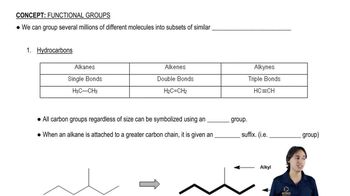
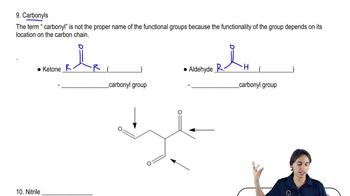
Aldehydes have a terminal carbonyl group (–CHO), while ketones have an internal carbonyl group (C=O bonded to two carbons).
Track progress
Control buttons has been changed to "navigation" mode.
1/39
Related flashcards
Related practice
Recommended videos
Functional Groups quiz #1
Functional Groups
38 Terms
Functional Groups quiz #2
Functional Groups
40 Terms
Functional Groups quiz #3
Functional Groups
39 Terms
Functional Groups
2. Molecular Representations
6 problems
Topic
Johnny
How To Determine Solubility
2. Molecular Representations
7 problems
Topic
Johnny
2. Molecular Representations
3 topics
10 problems
Chapter
Ernest
01:30
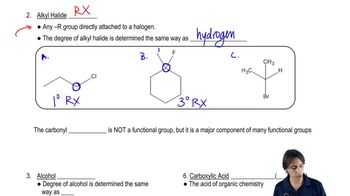
Assigning Degrees to Alkyl Halides
4818
views
50
rank
6
comments
01:49
Why we need functional groups.
6665
views
93
rank
3
comments
03:08
The difference between aldehydes and ketones.
4739
views
43
rank
9
comments
Terms in this set (39)
Hide definitions
How will you distinguish an unknown aldehyde from an unknown ketone?
Aldehydes have a terminal carbonyl group (–CHO), while ketones have an internal carbonyl group (C=O bonded to two carbons).
Which molecule shown has a carbonyl functional group in the form of a ketone?
A molecule with a C=O group bonded to two carbons is a ketone.
Which is a general representation of a secondary amine?
A secondary amine is represented as R2NH.
This compound is a subunit for what class of organic compounds if it contains an amino and carboxyl group?
It is a subunit for amino acids.
What is the general formula for the homologous series that includes ethene?
The general formula for alkenes is CnH2n.
A compound has the molecular formula C3H8. Which class of organic compounds does it belong to?
C3H8 is an alkane (propane).
What kind of compound is urea?
Urea is an amide.
The complexity and variety of organic molecules is due to what property of carbon?
Carbon’s ability to form four covalent bonds and bond to itself leads to complexity and variety.
What are functional groups in organic chemistry?
Functional groups are specific groups of atoms within molecules that determine their chemical reactivity.
All organic molecules contain which element?
All organic molecules contain carbon.
A feature of organic compounds not found in inorganic compounds is the presence of what?
Organic compounds feature carbon atoms bonded to other elements.
What are the main functional groups in organic chemistry?
Main functional groups include alcohols, amines, ethers, aldehydes, ketones, carboxylic acids, esters, amides, and alkyl halides.
Most organic compounds contain carbon and which other element?
Most organic compounds contain carbon and hydrogen.
Which chemical group is most likely to be responsible for an organic molecule behaving as a base?
The amino group (–NH2) is most likely responsible for basic behavior.
Organic molecules contain which elements?
Organic molecules contain carbon, hydrogen, and often oxygen and nitrogen.
Name the functional group shown in a molecule with a –COOH group.
The functional group is a carboxylic acid.
The element present in all organic molecules is?
Carbon.
Most organic compounds contain which atoms?
Most organic compounds contain carbon and hydrogen atoms.
What important element makes up the skeletons of organic compounds?
Carbon makes up the skeletons of organic compounds.
Which organic molecules contain both an amine and carboxyl group?
Amino acids contain both an amine and carboxyl group.
Which group is characteristic of thiols?
The –SH group is characteristic of thiols.
Most organic compounds contain carbon and what other element?
Most organic compounds contain carbon and hydrogen.
Organic compounds are distinguished by molecules that contain what bonded to other elements?
Organic compounds contain carbon bonded to other elements.
Which compound has a functional group that contains two oxygen atoms?
Esters and carboxylic acids have functional groups with two oxygen atoms.
Using acetylene as your only source of carbon atoms, what type of compound can you synthesize?
You can synthesize alkynes and other compounds with triple bonds.
A molecule contains four functional groups: alcohol, amine, carboxylic acid, and ester. What are their general formulas?
Alcohol: –OH; Amine: –NH2; Carboxylic acid: –COOH; Ester: –COOR.
Most organic compounds contain carbon and what other element?
Most organic compounds contain carbon and hydrogen.
Which functional group does a molecule with a –COOH group have?
It has a carboxylic acid functional group.
How can carbon skeletons vary?
Carbon skeletons can vary in length, branching, and the presence of rings or double/triple bonds.
Which functional group shown can pick up protons and raise the pH of the surrounding solution?
The amino group (–NH2) can pick up protons and act as a base.
A molecule with the formula C18H36O2 is probably a?
It is probably a fatty acid (lipid).
What is the relationship between two molecules that are structural isomers?
Structural isomers have the same molecular formula but different connectivity of atoms.
Identify each property as that of alcohols, ethers, or both.
Alcohols: contain –OH, can hydrogen bond; Ethers: contain R–O–R, less hydrogen bonding; Both: contain oxygen.
Molecules that contain carbon, hydrogen, and oxygen are known as?
They are known as organic compounds.
Ethylene is an organic compound produced by ripening fruits. What is its functional group?
Ethylene is an alkene, containing a carbon-carbon double bond.
What are the characteristics of carbon skeletons?
Carbon skeletons can vary in length, branching, and ring structure.
Which functional group can transfer energy among organic molecules?
Phosphate groups can transfer energy, but in basic organic chemistry, functional groups like esters are involved in energy transfer.
How do carbon skeletons vary?
Carbon skeletons vary in length, branching, and the presence of rings or multiple bonds.
The complexity and variety of organic molecules is due to what property of carbon?
Carbon’s ability to form four covalent bonds and bond to itself.
 BackBack

 01:30
01:30