Functional Groups quiz #12 Flashcards

Functional Groups quiz #12
Control buttons has been changed to "navigation" mode.
1/36
  • A common alkene starting material is shown below. What is its general formula?
    Alkenes have the general formula CnH2n.
  • Are solvents made from natural sources such as pine and citrus oils organic?
    Yes, they are organic compounds.
  • Classify these solvents as either protic or aprotic.
    Protic solvents contain –OH or –NH groups; aprotic solvents do not.
  • Draw the monomer for a polymer made from vinyl acetate.
    The monomer is CH2=CHOCOCH3 (vinyl acetate).
  • Classify each solvent as polar or nonpolar and as protic or aprotic.
    Polar: water, alcohols; Nonpolar: hexane; Protic: water, alcohols; Aprotic: acetone, DMSO.
  • Identify the circled functional group if it is –COOH.
    It is a carboxylic acid.
  • Determine the repeat unit for the polymer produced from vinyl acetate.
    The repeat unit is –[CH2–CH(OCOCH3)]–.
  • Organic molecules are those that contain at least which element?
    Organic molecules contain at least carbon.
  • What is the structure of OCH2CH3?
    It is an ethoxy group, characteristic of ethers.
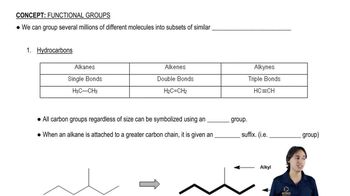
  • Modify the given carbon skeleton by adding a methyl group.
    Attach a –CH3 group to the carbon skeleton.
  • Classify each structure according to its functional class if it contains –OH, –COOH, or –NH2.
    –OH: alcohol; –COOH: carboxylic acid; –NH2: amine.
  • Name the highlighted chemical group in a molecule with a –COOH group.
    It is a carboxylic acid group.
  • Identify the functional group in a molecule with a –COOR group.
    It is an ester.
  • Is FCN polar or nonpolar?
    FCN is polar due to the electronegative atoms.
  • Determine the type of alcohol represented by a structure with the –OH group on a secondary carbon.
    It is a secondary alcohol.
  • What is the structure of CH3CH2CHCH(OH)?
    It is a secondary alcohol (2-butanol).
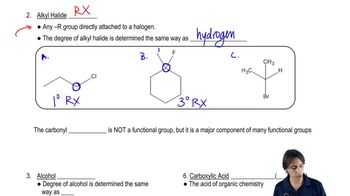
  • Consider the structure of an alkyl halide. What is its general formula?
    The general formula is R–X, where X is a halogen.
  • Which one of these is an amino group?
    The amino group is –NH2.
  • Identify the carbon atom that should be designated as #1 in a chain with a functional group.
    The carbon attached to the highest priority functional group is designated as #1.
  • What is the structure of C3H7OCl?
    It is an alkyl chloride with three carbons and an oxygen atom.
  • What is the relationship between 3-chloro-3-methylhexane and methanol?
    They are different organic compounds: one is an alkyl halide, the other is an alcohol.
  • How many substituents does a tertiary carbon have?
    A tertiary carbon has three substituents (carbon groups) attached.
  • Thiols have structures similar to alcohols except that they contain what atom?
    Thiols contain a sulfur atom (–SH) instead of oxygen.
  • Classify each of the following compounds according to its functional group: alcohol, amine, ester.
    Alcohol: –OH; Amine: –NH2; Ester: –COOR.
  • Classify organic compounds by the class of their functional group.
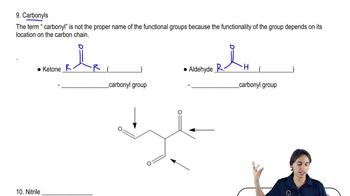
    Alcohols: –OH; Aldehydes: –CHO; Ketones: C=O; Carboxylic acids: –COOH; Esters: –COOR; Amines: –NH2.
  • Label the highlighted functional groups in a molecule with –OH, –COOH, and –NH2.
    –OH: alcohol; –COOH: carboxylic acid; –NH2: amine.
  • Consider the reaction described by the equation C2H4Br2. What is the functional group present?
    It is an alkyl halide (dibromoethane).
  • What is the repeat unit of polycarbonate?
    The repeat unit contains carbonate groups (–O–CO–O–) linked to aromatic rings.
  • Is CN electron withdrawing?
    Yes, the cyano (–CN) group is electron withdrawing.
  • What functional group is present in dibenzalacetone?
    Dibenzalacetone contains a ketone functional group.
  • What is the parent chain of a compound with six carbons?
    The parent chain is hexane.
  • Classify each substituent as electron donating or electron withdrawing.
    Alkyl groups are electron donating; nitro, cyano, and halogens are electron withdrawing.
  • Classify each structure according to its functional group: alcohol, amine, ester.
    Alcohol: –OH; Amine: –NH2; Ester: –COOR.
  • Which formula represents an organic compound?
    Any formula containing carbon and hydrogen, such as C2H6, is organic.
  • Identify the structures of compounds A to E if they contain –OH, –COOH, –NH2, –COOR, and –CHO groups.
    A: alcohol; B: carboxylic acid; C: amine; D: ester; E: aldehyde.
  • Is SF2 polar or nonpolar?
    SF2 is polar due to its bent shape and electronegative atoms.