What type of bond joins the carboxyl (COOH) group of one molecule to the amino (NH2) group of another molecule?
An amide bond (also called a peptide bond) joins the carboxyl group of one molecule to the amino group of another.
Which type of molecule contains only single bonds between carbon atoms?
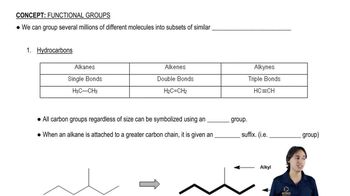
Alkanes contain only single bonds between carbon atoms.
What is the classification of a molecule that contains carbon and hydrogen atoms?
A molecule containing carbon and hydrogen atoms is classified as organic.
Why can carbon form very large molecules?
Carbon can form very large molecules because it can make four covalent bonds, allowing it to bond to other carbons and form long chains and complex structures.
What functional group is represented by the atoms in a carboxylic acid?
The carboxylic acid functional group is represented by the COOH group.
Which group is characteristic of thiols?
The –SH group is characteristic of thiols.
What is the chemical structure of an amino group?
An amino group is represented as –NH2.
Why are hydrocarbons insoluble in water?
Hydrocarbons are insoluble in water because they are nonpolar, while water is polar.
Which type of organic compound is the main source of energy for living things?
Carbohydrates are the main source of energy for living things.
Which functional group is characteristic of alcohols?
The hydroxyl group (–OH) is characteristic of alcohols.
Most organic compounds contain which atoms?
Most organic compounds contain carbon and hydrogen atoms.
How are the building blocks of organic molecules similar to bricks?
The building blocks of organic molecules are like bricks because they can be joined together to form larger structures.
How do organic compounds differ from inorganic compounds?
Organic compounds contain carbon atoms bonded to other elements, while inorganic compounds generally do not have carbon-hydrogen bonds.
Which general formula represents the functional group in a carboxylic acid?
The general formula for a carboxylic acid functional group is RCOOH.
What is an organic molecule with carbon?
An organic molecule with carbon is any molecule that contains carbon atoms bonded to other elements, typically hydrogen.
Which general formula represents the functional group in a carboxylic acid?
The general formula for a carboxylic acid is RCOOH.
Which type of compound is composed of alkenes?
Alkenes are composed of molecules with at least one carbon-carbon double bond.
Which class of organic compound is commonly used in perfumes?
Esters are commonly used in perfumes due to their pleasant fragrances.
What is a property of all alkanes?
All alkanes are saturated hydrocarbons containing only single bonds between carbon atoms.
Organic compounds are those that contain what element?
Organic compounds contain the element carbon.
What is the chemical formula for propane?
The chemical formula for propane is C3H8.
What functional group accounts for the acidic behavior in vinegar?
The carboxylic acid (COOH) functional group accounts for the acidic behavior in vinegar.
What defines a secondary alcohol?
A secondary alcohol has the general structure R2CHOH, where the hydroxyl group is attached to a carbon bonded to two other carbons.
Which formula represents an organic compound?
Any formula containing carbon and hydrogen, such as CH4, represents an organic compound.
What element do all organic compounds contain?
All organic compounds contain carbon.
Which formula represents an unsaturated hydrocarbon?
Formulas with double or triple bonds, such as C2H4 (alkene) or C2H2 (alkyne), represent unsaturated hydrocarbons.
Which functional group increases the solubility of organic compounds in water?
Functional groups such as hydroxyl (–OH), carboxyl (–COOH), and amino (–NH2) increase solubility in water due to their polarity.
How many carbon-carbon double bonds are present in the structure of ibuprofen?
Ibuprofen contains one carbon-carbon double bond in its structure.
What is the general formula for a secondary amine?
The general formula for a secondary amine is R2NH.
What characterizes an organic compound?
Any compound containing carbon and hydrogen, such as CH4, represents an organic compound.
How many hydrogens are connected to a tertiary carbon atom?
A tertiary carbon atom is bonded to three other carbons and typically has one hydrogen attached.
For what purpose are aniline dyes used?
Aniline dyes are used for coloring fabrics and hair.
What is the general structure of a tertiary amine?
A tertiary amine has the general structure R3N, where nitrogen is bonded to three carbon groups.
Which of these is a thiol?
A thiol contains the –SH functional group.
Which C=O functional group is present in a ketone?
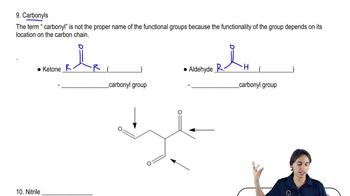
A ketone contains a carbonyl group (C=O) bonded to two carbon atoms.
Which compound has a functional group that contains two oxygen atoms?
Esters and carboxylic acids have functional groups containing two oxygen atoms.
What group distinguishes alcohols from other classes of compounds?
The hydroxyl group (–OH) distinguishes alcohols from other classes of compounds.
Which element must be present in an organic compound?
Carbon must be present in an organic compound.
What is the chemical structure characteristic of steroids?
Steroids have a structure consisting of four fused carbon rings.
The atoms of which element bond to one another in chains?
 Back
Back

 01:30
01:30