Skip to main content
Organic Chemistry
My Course
Learn
Exam Prep
AI Tutor
Study Guides
Textbook Solutions
Flashcards
Explore
Try the app
My Course
Learn
Exam Prep
AI Tutor
Study Guides
Textbook Solutions
Flashcards
Explore
Try the app
Back
Functional Groups quiz #8
You can tap to flip the card.
What is the fundamental element found in all organic compounds studied by chemists?
You can tap to flip the card.
👆
What is the fundamental element found in all organic compounds studied by chemists?
Carbon is the fundamental element in all organic compounds.
Track progress
Control buttons has been changed to "navigation" mode.
1/38
Related flashcards
Related practice
Recommended videos
Functional Groups quiz #1
Functional Groups
38 Terms
Functional Groups quiz #2
Functional Groups
40 Terms
Functional Groups quiz #3
Functional Groups
39 Terms
Functional Groups
2. Molecular Representations
6 problems
Topic
Johnny
How To Determine Solubility
2. Molecular Representations
7 problems
Topic
Johnny
2. Molecular Representations
3 topics
10 problems
Chapter
Ernest
01:30
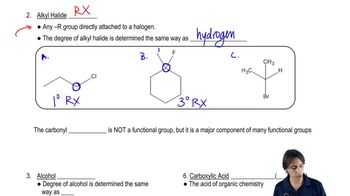
Assigning Degrees to Alkyl Halides
4813
views
50
rank
6
comments
01:49
Why we need functional groups.
6660
views
93
rank
3
comments
03:08
The difference between aldehydes and ketones.
4737
views
43
rank
9
comments
Terms in this set (38)
Hide definitions
What is the fundamental element found in all organic compounds studied by chemists?
Carbon is the fundamental element in all organic compounds.
What do all organic compounds contain?
All organic compounds contain carbon.
Which functional group is found in an amine?
The amino group (–NH2, –NHR, or –NR2) is found in amines.
Which structure represents an amine?
A structure with a nitrogen atom bonded to carbon and/or hydrogen atoms represents an amine.
Which group is the least reactive among alkanes, alkenes, and alkynes?
Alkanes are the least reactive among these hydrocarbon groups.
What two elements have four valence electrons and are capable of forming long covalent chains?
Carbon and silicon both have four valence electrons and can form long covalent chains.
What functional group characterizes an ether?
A compound with the functional group R–O–R is an ether.
Which element is always associated with organic chemistry?
Carbon is always associated with organic chemistry.
What kind of taste do carboxylic acids have?
Carboxylic acids typically have a sour taste.
Which portion of a molecule represents a carboxylic acid?
The portion containing the –COOH group represents a carboxylic acid.
Which example is most likely an organic compound?
A compound containing carbon and hydrogen, such as CH4, is most likely organic.
Which molecule corresponds to the monomer used to produce poly(vinyl acetate)?
Vinyl acetate is the monomer used to produce poly(vinyl acetate).
What structural feature defines ylides?
Ylides are compounds with adjacent positive and negative charges on different atoms, typically involving phosphorus or sulfur.
What chemical process is responsible for the smell of vinegar in an old bottle of aspirin?
Hydrolysis of aspirin produces acetic acid, which gives the smell of vinegar.
What is the organic compound with the general formula R–X?
The general formula R–X represents an alkyl halide, where X is a halogen.
Which molecule is an ester?
A molecule with the functional group –COOR is an ester.
Which organic molecules contain both an amine and carboxyl group?
Amino acids contain both an amine (–NH2) and a carboxyl (–COOH) group.
The COOH group represents which functional group?
The COOH group represents the carboxylic acid functional group.
Which of these functional groups contains nitrogen?
Amines and amides contain nitrogen.
What functional group is revealed by a strong IR absorption near 1700 cm–1?
A strong IR absorption near 1700 cm–1 indicates a carbonyl (C=O) functional group.
What type of bond do alkynes contain?
Alkynes contain carbon-carbon triple bonds.
How many lone pairs of electrons does the oxygen in a carbonyl group have?
The oxygen in a carbonyl group has two lone pairs of electrons.
What formula represents an organic compound?
Any formula containing carbon and hydrogen, such as C2H6, represents an organic compound.
What is a benzylic cation?
A benzylic cation is a carbocation adjacent to a benzene ring.
Which is a compound that contains carbon?
Any organic compound contains carbon.
What do methane (CH4) and butane (C4H10) have in common?
Both methane and butane are alkanes, saturated hydrocarbons containing only single bonds.
Which functional groups are associated with a dehydration reaction?
Alcohols and carboxylic acids are commonly involved in dehydration reactions, such as esterification.
What element do all organic compounds contain: carbon, hydrogen, nitrogen, or oxygen?
All organic compounds contain carbon.
All organic compounds contain which element?
All organic compounds contain carbon.
How many carbon atoms are in butane?
Butane contains four carbon atoms.
Give an example of an organic chemical compound.
Ethanol (C2H5OH) is an example of an organic chemical compound.
What are defined as repeating units in all organic compounds?
Monomers are repeating units in polymers, which are large organic compounds.
Why is carbon present in so many types of molecules?
Carbon can form four covalent bonds, allowing for a variety of structures and large molecules.
How is an organic compound described?
An organic compound contains carbon atoms bonded to other elements, usually hydrogen.
How many hydrogen atoms is the carbonyl group in a ketone bonded to?
The carbonyl carbon in a ketone is bonded to zero hydrogen atoms; it is bonded to two carbons.
Alkenes are referred to as what type of compounds?
Alkenes are unsaturated hydrocarbons containing at least one carbon-carbon double bond.
Alcohols contain which functional group?
Alcohols contain the hydroxyl (–OH) functional group.
What are terpenes?
Terpenes are organic compounds built from isoprene units, often found in essential oils.
 BackBack

 01:30
01:30