Back

Monosaccharide definitions

Control buttons has been changed to "navigation" mode.
1/14
  • Carbohydrate

    A molecule composed of carbon and water in a fixed ratio, serving as a fundamental energy source in living organisms.
  • Monosaccharide

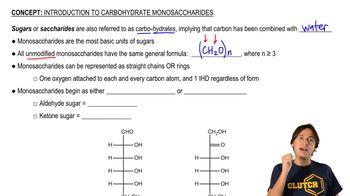
    The simplest unit of sugar, featuring a general formula of CH2O repeated n times, where n is 3 or greater.
  • Saccharide

    A term used interchangeably with sugar and carbohydrate, referring to molecules built from carbon, hydrogen, and oxygen.
  • Aldose

    A sugar molecule containing an aldehyde functional group, typically located at the terminal carbon.
  • Ketose

    A sugar molecule containing a ketone functional group, always positioned at least on the second carbon.
  • Stereoisomer

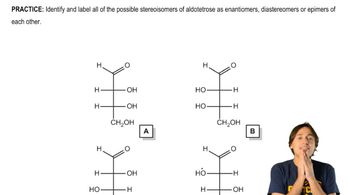
    A molecule sharing the same formula and connectivity as another but differing in the spatial arrangement of atoms.
  • Epimer

    A stereoisomer of a sugar that differs from another only at a single chiral center.
  • Chiral Center

    A carbon atom bonded to four distinct groups, giving rise to non-superimposable mirror images.
  • Fischer Projection

    A two-dimensional representation used to depict the stereochemistry of sugars, highlighting chiral centers.
  • IHD

    A measure of unsaturation in a molecule, indicating the presence of rings or double bonds.
  • Triose

    A monosaccharide containing three carbon atoms, representing the smallest possible sugar.
  • Tetrose

    A monosaccharide containing four carbon atoms, named using pre-IUPAC conventions.
  • Pentose

    A monosaccharide with a five-carbon backbone, commonly found in biological systems.
  • Hexose

    A monosaccharide with six carbon atoms, including important sugars like glucose.