Skip to main content
Organic Chemistry
My Course
Learn
Exam Prep
AI Tutor
Study Guides
Textbook Solutions
Flashcards
Explore
Try the app
My Course
Learn
Exam Prep
AI Tutor
Study Guides
Textbook Solutions
Flashcards
Explore
Try the app
Back
Nitrogenous Bases definitions
You can tap to flip the card.
Nitrogenous Bases
You can tap to flip the card.
👆
Nitrogenous Bases
Molecules containing nitrogen that serve as fundamental components of nucleic acids, divided into two structural categories.
Track progress
Control buttons has been changed to "navigation" mode.
1/15
Related flashcards
Related practice
Recommended videos
Nitrogenous Bases quiz #1
Nitrogenous Bases
40 Terms
Nitrogenous Bases quiz #2
Nitrogenous Bases
27 Terms
Nitrogenous Bases
34. Nucleic Acids
5 problems
Topic
Naming Nucleosides and Nucleotides
34. Nucleic Acids
5 problems
Topic
34. Nucleic Acids - Part 1 of 2
4 topics
12 problems
Chapter
34. Nucleic Acids - Part 2 of 2
3 topics
9 problems
Chapter
Guided course
1:23
Nitrogenous Bases Example 3
664
views
Guided course
1:57
Nitrogenous Bases Example 2
516
views
Guided course
3:16
Nitrogenous Bases Concept 2
708
views
Terms in this set (15)
Hide definitions
Nitrogenous Bases
Molecules containing nitrogen that serve as fundamental components of nucleic acids, divided into two structural categories.
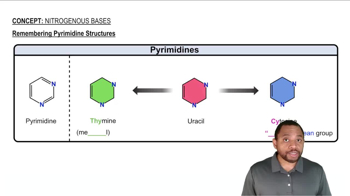
Pyrimidines
Single-ringed molecules including Cytosine, Thymine, and Uracil, each with unique functional group modifications.
Purines
Double-ringed molecules, specifically Adenine and Guanine, characterized by four embedded nitrogen atoms.
Cytosine
A pyrimidine with one carbonyl and one amine group, differing from others by its NH2 functional group.
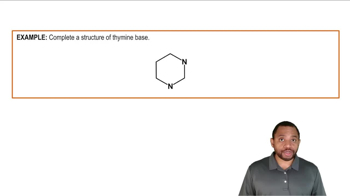
Thymine
A DNA-exclusive pyrimidine, structurally similar to Uracil but distinguished by an additional methyl group.
Uracil
An RNA-exclusive pyrimidine featuring two carbonyl groups and each nitrogen bonded to a hydrogen.
Adenine
A purine with an added amine group (NH2) on its ring structure, maintaining a double bond on one nitrogen.
Guanine
A purine containing both a carbonyl and an amine group, with nitrogen bonding adjusted to accommodate these groups.
Methyl Group
A functional group consisting of one carbon and three hydrogens, present in Thymine but absent in Uracil.
Amine Group
A functional group (NH2) found in Cytosine, Adenine, and Guanine, influencing hydrogen bonding and base pairing.
Carbonyl Group
A functional group (C=O) present in Uracil, Thymine, Cytosine, and Guanine, affecting base structure and reactivity.
Single Ring Structure
A molecular framework characteristic of pyrimidines, providing a compact, planar shape.
Double Ring Structure
A fused two-ring system found in purines, increasing molecular complexity and nitrogen content.
Nucleic Acids
Macromolecules such as DNA and RNA, constructed from sequences of nitrogenous bases.
Base Pairing
The specific hydrogen bonding interactions between nitrogenous bases, essential for nucleic acid structure.
 BackBack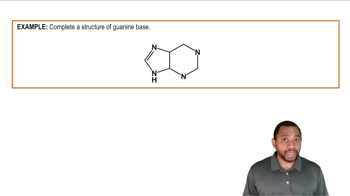
 1:23
1:23