Skip to main content
Organic Chemistry
My Course
Learn
Exam Prep
AI Tutor
Study Guides
Textbook Solutions
Flashcards
Explore
Try the app
My Course
Learn
Exam Prep
AI Tutor
Study Guides
Textbook Solutions
Flashcards
Explore
Try the app
Back
Organic Chemistry Reactions quiz #11
You can tap to flip the card.
How do you determine the major organic product for a reaction scheme?
You can tap to flip the card.
👆
How do you determine the major organic product for a reaction scheme?
Determine the major product by analyzing each step and applying the relevant mechanisms.
Track progress
Control buttons has been changed to "navigation" mode.
1/39
Related flashcards
Related practice
Recommended videos
Organic Chemistry Reactions quiz #1
Overview of Chemical Reactions
39 Terms
Organic Chemistry Reactions quiz #2
Overview of Chemical Reactions
38 Terms
Organic Chemistry Reactions quiz #3
Overview of Chemical Reactions
39 Terms
Organic Chemistry Reactions
3. Acids and Bases
1 problem
Topic
Reaction Mechanism
3. Acids and Bases
7 problems
Topic
Johnny
3. Acids and Bases - Part 1 of 2
4 topics
10 problems
Chapter
Laura
3. Acids and Bases - Part 2 of 2
3 topics
9 problems
Chapter
Johnny
01:34
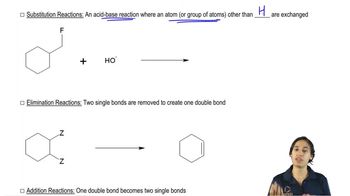
Recognizing Substitution Reactions.
4185
views
47
rank
5
comments
02:43
Recognizing Acid-Base Reactions.
5007
views
61
rank
9
comments
00:40
Recognizing Elimination Reactions.
3674
views
33
rank
2
comments
Terms in this set (39)
Hide definitions
How do you determine the major organic product for a reaction scheme?
Determine the major product by analyzing each step and applying the relevant mechanisms.
How does the chlorination of propane proceed as a radical chain reaction?
Chlorination of propane proceeds via initiation, propagation, and termination steps in a radical chain mechanism.
What is the role of acid chlorides in organic reactions?
Acid chlorides are reactive acylating agents used in substitution and addition reactions.
How do you draw the major products for a reaction?
Draw the major products by applying the reaction mechanism and showing the new bonds formed.
How do you determine the major product for a reaction?
Determine the major product by considering the reaction type and the stability of possible products.
How do you predict the major product for a reaction?
Predict the major product by analyzing the reaction mechanism and the stability of products.
How do you draw the product of a reaction sequence?
Draw the product by following each step and applying the relevant mechanisms.
How do you give the major product for a reaction?
Give the major product by considering the reaction type and the stability of possible products.
How do you draw the major organic product for a reaction with excess reagents?
Draw the major product by applying the reaction mechanism and considering the effect of excess reagents.
How do you draw the major product of a reaction, ignoring inorganic byproducts?
Draw the major product by applying the reaction mechanism and omitting inorganic byproducts.
How do you predict the final organic product of a two-step sequence?
Predict the final product by applying the mechanisms of both steps in sequence.
How do you draw the organic product of each step in a synthesis?
Draw the product of each step by applying the relevant reaction mechanism.
How do you predict the major product of a reaction sequence?
Predict the major product by analyzing each step and applying the relevant mechanisms.
How do you predict the major and minor products for a reaction?
Predict the major and minor products by considering the reaction mechanism and the stability of possible products.
How do you determine the expected major product of a reaction?
Determine the expected major product by analyzing the reaction mechanism and the stability of products.
How do you supply the correct major product formed from a reaction?
Supply the major product by applying the reaction mechanism and drawing the resulting compound.
How do you determine the major product of a reaction?
Determine the major product by considering the reaction type and the stability of possible products.
How do you compare the rates of two elimination reactions?
Compare the rates by considering the structure of the substrate, the base, and the reaction conditions.
How do you predict the intermediate and product for a reaction sequence?
Predict the intermediate and product by applying the mechanisms of each step in the sequence.
How do you choose the reagent(s) most likely to complete a reaction?
Choose reagents that match the required reaction type and functional group transformation.
How do you draw the organic products formed in a reaction?
Draw the products by applying the reaction mechanism and showing the new bonds formed.
How do you select appropriate reagents to achieve a synthetic transformation?
Select reagents based on the desired reaction type and the functional groups involved.
How do you draw the major product of a reaction, including stereochemistry if applicable?
Draw the major product by applying the reaction mechanism and indicating stereochemistry if relevant.
How do you predict the major organic product of the reaction of 2-methyl-1-propene?
Predict the major product by considering the reaction type and the stability of possible products.
How do you draw the major organic product for two different reaction conditions?
Draw the major product for each condition by applying the relevant reaction mechanism.
How do you construct a three-step synthesis of trans-2-pentene?
Construct the synthesis by selecting appropriate reactions to convert the starting material into trans-2-pentene.
What is the best choice of reagent to accomplish a transformation?
The best reagent is one that efficiently promotes the desired reaction mechanism.
How do you predict the major product of a reaction?
Predict the major product by considering the reaction type and the stability of possible products.
How do you draw the products expected from a reaction?
Draw the products by applying the reaction mechanism and showing the new bonds formed.
What is the outcome of the reaction of benzonitrile with methyl chloride and AlCl3?
The outcome is the alkylation of benzonitrile via a Friedel-Crafts reaction.
What is the major elimination product obtained from a reaction?
The major elimination product is typically the more substituted alkene, following Zaitsev's rule.
How do you give the product of a reaction?
Give the product by applying the reaction mechanism to the starting material.
How do you draw the major organic product for the same substrate under two different conditions?
Draw the major product for each condition by applying the relevant reaction mechanism.
How do you give the major product for a reaction?
Give the major product by considering the reaction type and the stability of possible products.
How do you draw the organic products formed in a reaction?
Draw the products by applying the reaction mechanism and showing the new bonds formed.
How do you classify a reaction as substitution, elimination, or addition?
Classify the reaction by analyzing the changes in bonds and atoms exchanged during the reaction.
How do you draw the organic product of a reaction?
Draw the organic product by applying the reaction mechanism to the reactants.
How do you identify the expected major product for a reaction?
Identify the expected major product by considering the reaction mechanism and the stability of products.
How do you draw the organic product of a given reaction?
Draw the organic product by applying the reaction mechanism to the starting material.
 BackBack

 01:34
01:34